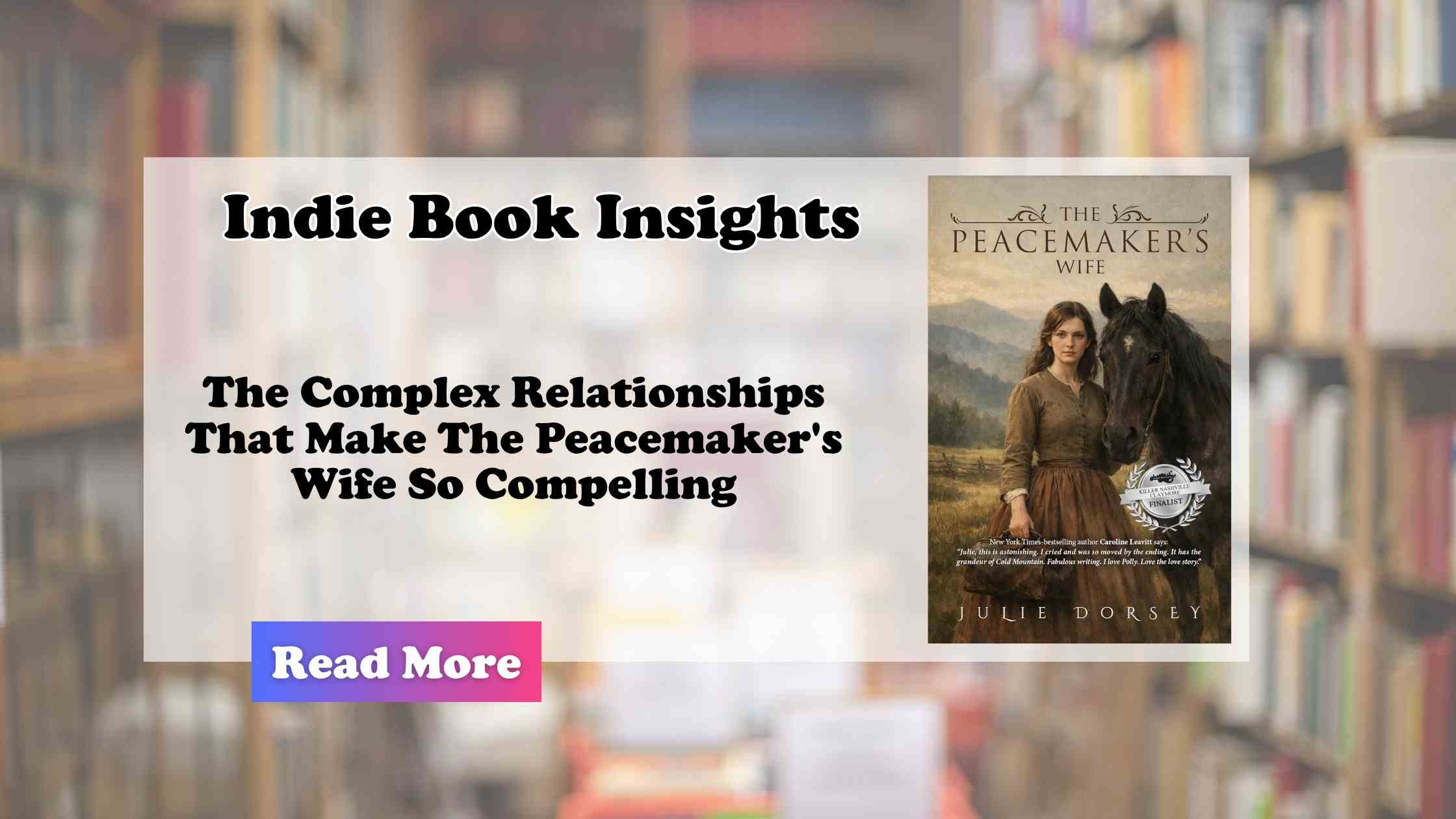
Every memorable historical novel needs more than a vivid setting. It needs relationships that feel alive, conflicted and emotionally true. In The Peacemaker’s Wife by Julie Dorsey, the relationships are not simple connections between characters. They are the force that drives the story forward, shaping Polly Justice’s choices, fears, longings and transformation.
Set in the Blue Ridge Mountains of North Carolina in 1857, the novel follows Polly Justice, a young woman caught between duty and desire, survival and selfhood, public reputation and private truth. Around her, every relationship carries weight. Some offer comfort. Some bring danger. Some force her to confront who she is and what kind of life she wants.
At the center of the novel is Polly’s marriage to John Justice. To the outside world, John is known as “The Peacemaker,” a man respected for settling disputes and keeping order in the community. Yet Polly sees the side of him that others do not. Behind closed doors, he is volatile, controlling and capable of cruelty. This contrast gives the marriage its emotional tension. Polly is bound to a man admired by others, yet she must live with the truth of his private behavior. The relationship raises one of the novel’s most gripping questions: what happens when the person everyone trusts becomes the person one woman fears most?
Polly’s connection to Sam Edney adds another layer of complexity. Sam represents love, longing and the life Polly might have chosen. Their bond is emotional and unresolved, filled with regret and temptation. Through Sam, the novel explores the painful space between what the heart wants and what duty demands. Polly’s feelings for him do not make her reckless. Instead, they reveal her humanity. She is a woman trying to remain loyal while carrying a love she cannot easily bury.
Equally important are Polly’s relationships with the women around her. Nan Clark, the experienced healer, becomes a guide and teacher, passing down knowledge of herbs, remedies, birth, illness and mountain wisdom. Their bond speaks to female inheritance, the quiet transfer of power between generations and the way women preserved life when formal authority was denied to them.
Candy Morrison brings friendship, vulnerability and shared pain into Polly’s world. Their relationship shows how women support one another in a society that often leaves them unprotected. Candy is not merely a side character. She reflects another form of survival, another woman navigating judgment, danger and the consequences of men’s actions.
Polly’s family relationships also deepen the story. Her guilt over Lucindy, her respect for her father and her bond with her mother all shape her desire to become a healer. These ties give emotional history to her calling. Polly does not simply want to help others. She wants to atone, to learn and to prevent pain where she can.
What makes these relationships compelling is that none of them are flat. Love is mixed with resentment. Loyalty is tested by fear. Friendship is shaped by grief. Marriage is complicated by power. Desire is restrained by conscience.
Julie Dorsey uses these layered relationships to create a historical novel that feels intimate and urgent. The Peacemaker’s Wife is compelling because it understands that people are rarely simple and the bonds between them can both wound and save.
Grab your copy: https://www.amazon.com/dp/B0GHKW5LCV/