

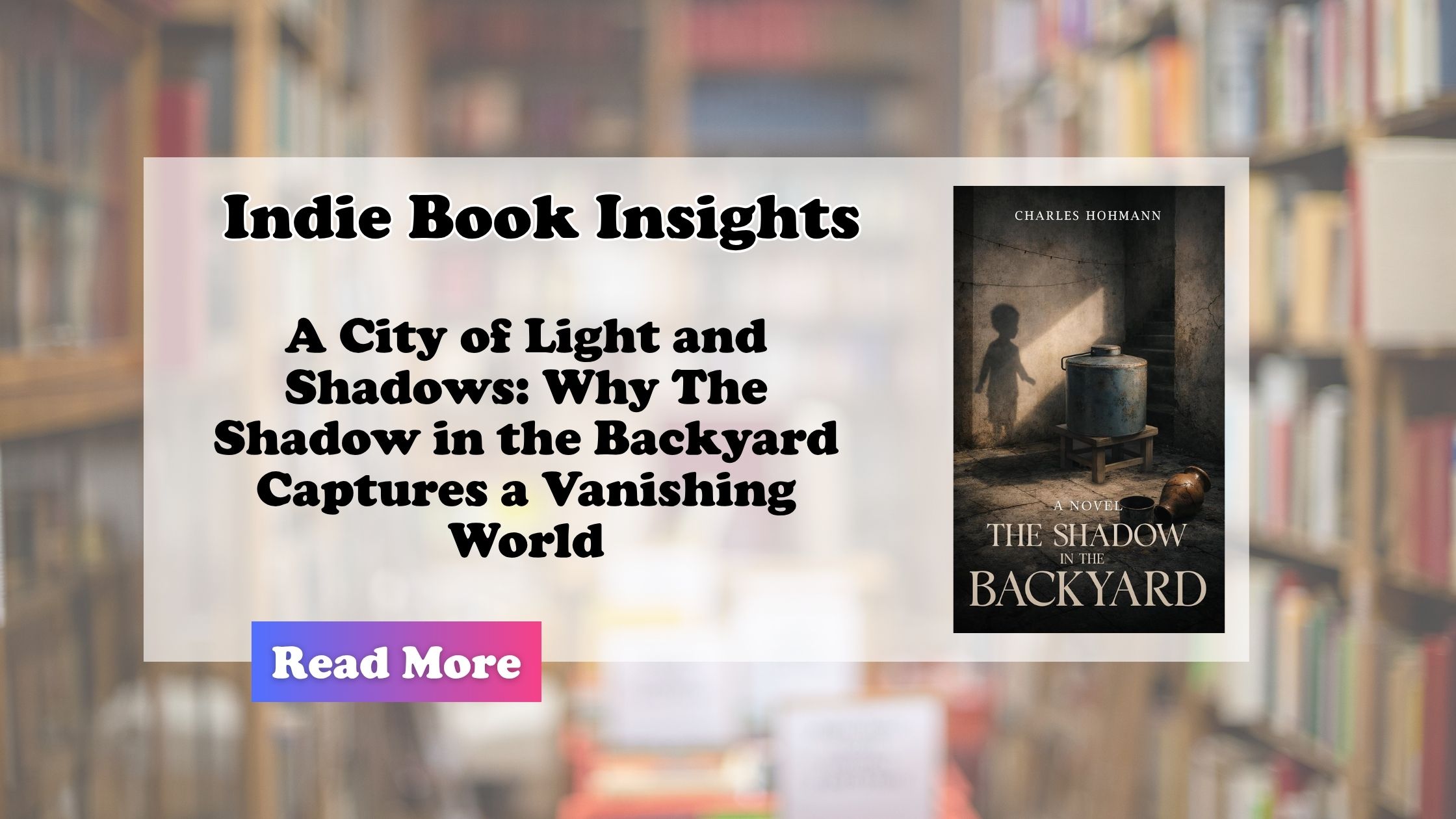
In Charles Hohmann’s novel The Shadow in the Backyard, Alexandria is never just a backdrop. It is the central character of a city of overlapping languages, fragile coexistence and luminous contradictions slowly dissolving under the weight of history.
Set in the 1930s, the novel captures Alexandria at a moment when cosmopolitan life still exists, but already feels precarious. Europeans, Egyptians, Levantines and expatriates move through the same streets, cafés and bookshops, sharing space without fully sharing meaning. It is a world held together not by unity but by proximity.
At the heart of this city stands Louis Schuler, a bookshop owner whose shop becomes a quiet anchor in a shifting landscape. In The Shadow in the Backyard, the bookshop is more than a place of reading; it is a fragile ecosystem of ideas where literature, philosophy and politics intersect. British officers browse alongside Egyptian students. Artists debate beside diplomats. Every conversation carries the possibility of connection, but also the risk of exposure.
What gives the novel its emotional depth is the way it captures a world that is still alive, yet already disappearing. Alexandria is portrayed as radiant but unstable, its beauty inseparable from its fragility. The sea, the light and the multilingual rhythm of daily life all suggest openness, yet beneath this surface lies growing unease. Surveillance increases. Conversations become cautious. Even intellectual curiosity begins to feel dangerous.
Schuler’s bookshop reflects this transformation in miniature. Once a space of open exchange, it gradually becomes a place where words are weighed before they are spoken. Books that once invited discussion now invite scrutiny. Titles by Freud, Marx, Dostoyevsky and surrealist writers circulate not only as literature but as potential signals of dissent. In this environment, reading itself becomes a subtle act of resistance.
Yet The Shadow in the Backyard resists nostalgia. It does not idealize Alexandria as a lost paradise. Instead, it presents cosmopolitanism as something both real and unstable, an achievement that depends on constant negotiation. The city’s brilliance lies precisely in its impermanence.
This sense of a vanishing world is reinforced through the novel’s attention to memory and hidden structures. Beneath the visible city lie underground cisterns, forgotten layers of history and submerged narratives that shape the present without announcing themselves. Alexandria becomes a metaphor for memory itself: layered, partially erased and still present in echoes.
The personal story of Louis and Marjorie deepens this vision. Their relationship unfolds not in isolation from history, but within it. Love here is not an escape from the world’s instability; it is shaped by it. As political tensions rise and Europe moves toward war, their private lives become inseparable from global uncertainty. Their journey across cities and borders mirrors the disintegration of the cosmopolitan order they once inhabited.
One of the novel’s most powerful ideas is that disappearance does not happen suddenly. It happens gradually, through small adjustments: a lowered voice, a closed door, a censored book, a conversation that never quite begins. In The Shadow in the Backyard, the vanishing world of Alexandria is not lost in a single moment, but in accumulated hesitation.
And yet, even within this fading landscape, the novel finds continuity. Light still falls across the harbor. Books are still opened. People still fall in love. These small acts do not stop history from changing, but they preserve something essential within it.
Ultimately, The Shadow in the Backyard is about the paradox of visibility and loss. It shows how cities can be brightest at the very moment they begin to disappear and how literature becomes a way of holding that brightness just long enough for it to be remembered.
Available on Amazon : https://www.amazon.com/dp/1971228729