

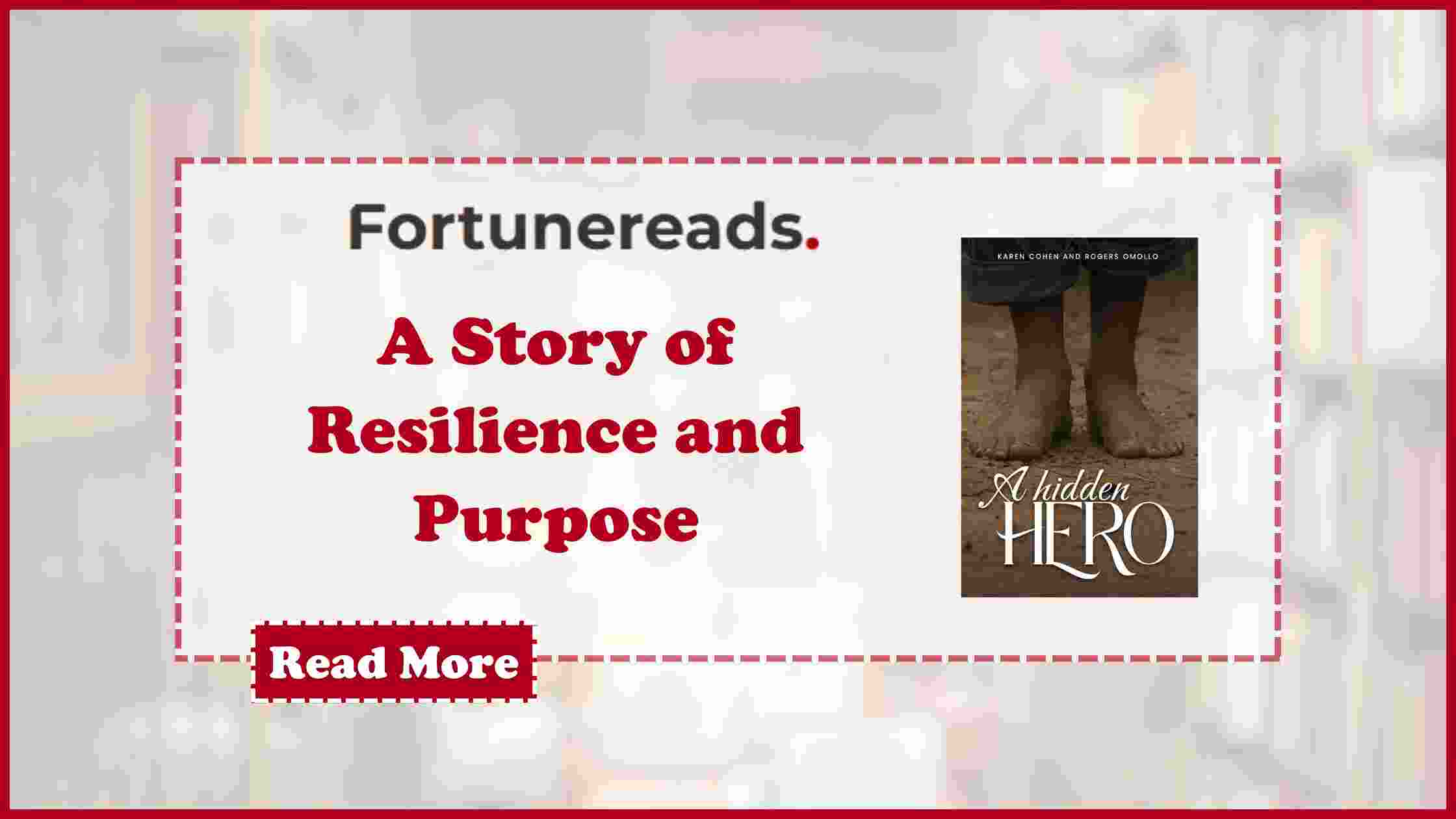
Some books are written to entertain, others to inform, and a few to inspire. A Hidden Hero by Rogers Omollo is a memoir that does not rely on dramatics or polished beginnings but instead tells an honest and straightforward story of what it means to grow up with little and still hold on to hope.
The book opens in Kamagaga, a rural village in Kenya, where Rogers’ life began. His early childhood was shaped by loss, poverty, and the determination of his grandmother, who raised him after the death of his parents. This set the tone for what follows, which is a reflection on the values that carried him forward. With this book, we quickly learn that faith, family, and the pursuit of education became anchors in a childhood where survival was never guaranteed.
One of the strongest features of the memoir is its simplicity. Rogers does not try to present his life as extraordinary in the traditional sense. Instead, he tells it plainly, and that honesty is what makes it powerful. He writes about working in rice fields as a teenager for just a few dollars a month, about dropping out of school when fees could not be paid, and about the emotional weight of walking long distances to class while tired from labor. These details ground the story and help readers see the human side of struggles often summarized by statistics.
What stands out is how Rogers never views education as a privilege just for himself. Even in his hardest moments, he saw it as a key that could also unlock opportunities for his community. That vision eventually shaped his work as a teacher. He turned classrooms into practical spaces, teaching agriculture not just as a subject but as a livelihood skill families could depend on. This shows one of the book’s main themes: resilience is not only about survival but about finding ways to lift others as you climb.
The transition from teacher to nonprofit founder is another part of the story that feels natural and believable. Out of his experiences came Activate Action, a grassroots organization built to empower young people with education, health services, and leadership training. Rogers writes about the long hours, the lack of funding, and the skepticism he faced. Still, he shares how persistence and partnerships turned small beginnings into meaningful impact.
Later chapters move beyond local efforts to describe Rogers’ involvement with groups like the African Population and Health Research Center, the Network for Adolescent and Youth of Africa, and the United Nations Population Fund. These sections remind readers that one person’s journey can ripple outward, reaching spaces they never imagined. Yet, he never loses sight of where it began: a small village, a grandmother’s wisdom, and the belief that education could change everything.
A Hidden Hero works because it avoids exaggeration. It does not claim to solve every problem, nor does it present its author as flawless. Instead, it offers an honest record of resilience, setbacks, and the ongoing work of community change. For readers, the value lies in its reminder that leadership often grows out of hardship and that small acts of persistence can add up to large transformations.
This is a book for students seeking motivation, educators who want to see the wider impact of their work, and anyone who wonders if ordinary lives can spark lasting change. If you are looking for motivation and strength to shape or improve your life and that of others, reading this book is a wise choice.
Head to Amazon to purchase your copy: https://www.amazon.com/dp/B0DZPZKYXF.