
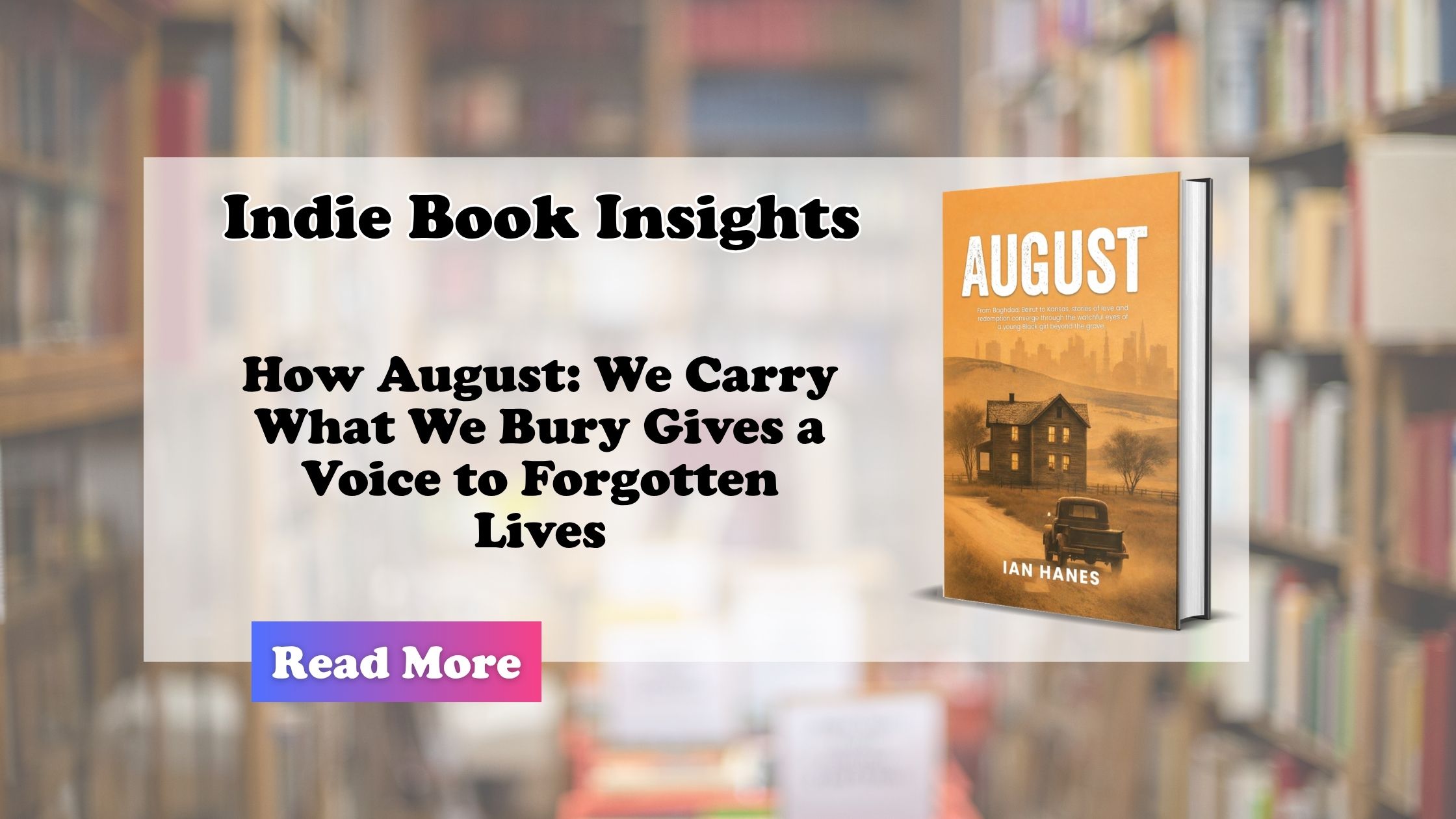
History often remembers public victories, powerful leaders and dramatic events. It does not always remember the people who lived quietly in the background the ones whose dreams were interrupted, whose losses went unacknowledged or whose names were never properly recorded. In August: We Carry What We Bury, author Ian Hanes brings those overlooked lives to the centre of the story.
The clearest example is Rose, a young Black girl growing up in 1970s Kansas. She is intelligent, observant and ambitious, with hopes of becoming a civil rights lawyer. Yet in the small town of Lebanon, she is constantly reminded that society does not see her in the same way it sees others.
Her relationship with August, a talented white basketball player, must remain hidden behind careful glances and private conversations. While August is celebrated by the town for his achievements on the basketball court, Rose is expected to stay quiet and unnoticed. She sits away from the front rows, understands the danger of gossip and learns how quickly prejudice can reduce a person’s identity.
However, Rose is not silent in the novel.
By allowing her to narrate much of the story from beyond the grave, Ian Hanes gives her the voice she was denied during her lifetime. Rose tells readers about her love, her humour, her fears and the future she imagined for herself. She is not presented simply as a victim of tragedy. She is shown as a complete person whose life held intelligence, courage and possibility.
Her death becomes one of the novel’s most painful moments. She is killed while trying to reach August’s championship basketball game and the people around her initially treat her death as little more than a detail connected to someone else’s story. Even her grave remains unmarked for years. This absence reflects a larger truth: many people disappear from public memory not because their lives lacked meaning, but because no one with influence chose to preserve their stories.
The novel also gives a voice to people affected by displacement, dictatorship, war and political neglect. Through characters connected to Baghdad and Beirut, readers encounter families who have lost homes, loved ones, safety and a sense of belonging. Their experiences show that forgotten lives exist across countries and generations.
Layla’s story, in particular, reflects the emotional cost of forced migration. Her family is shaped by political violence in Iraq, while her later life in Lebanon reveals the difficulties refugees face when trying to build a home in a country that may never fully accept them. Ian Hanes does not treat these people as statistics. He gives them relationships, memories, traditions, humour and hope.
The novel’s settings also reinforce this theme. Rural Kansas, Baghdad and Beirut may appear entirely different, but each place contains people carrying histories that the wider world rarely notices. Farmers remain after towns decline. Refugees live between identities. Families search for the truth about those who disappeared. The dead wait for someone to remember their names.
This is why the eventual recognition of Rose’s full identity carries so much power. When she is finally remembered as Rosalind “Rose” Carter, her name restores what prejudice and silence had taken from her. It confirms that she lived, dreamed, loved and mattered.
August: We Carry What We Bury gives forgotten lives the dignity of being seen. Through its characters, Ian Hanes reminds readers that remembrance is more than looking backward. It is an act of justice and sometimes the first step toward healing.