Among all myths and mysteries, few have held the human imagination as powerfully as Atlantis. For centuries, it has been pictured as a lost city beneath the sea, a place of coral covered pillars, vanished temples, and drowned splendour hidden somewhere in the Atlantic. Ever since Plato described a powerful civilisation swallowed by disaster in a single day and night, Atlantis has lived in our imagination as a beautiful ruin beneath the waves.
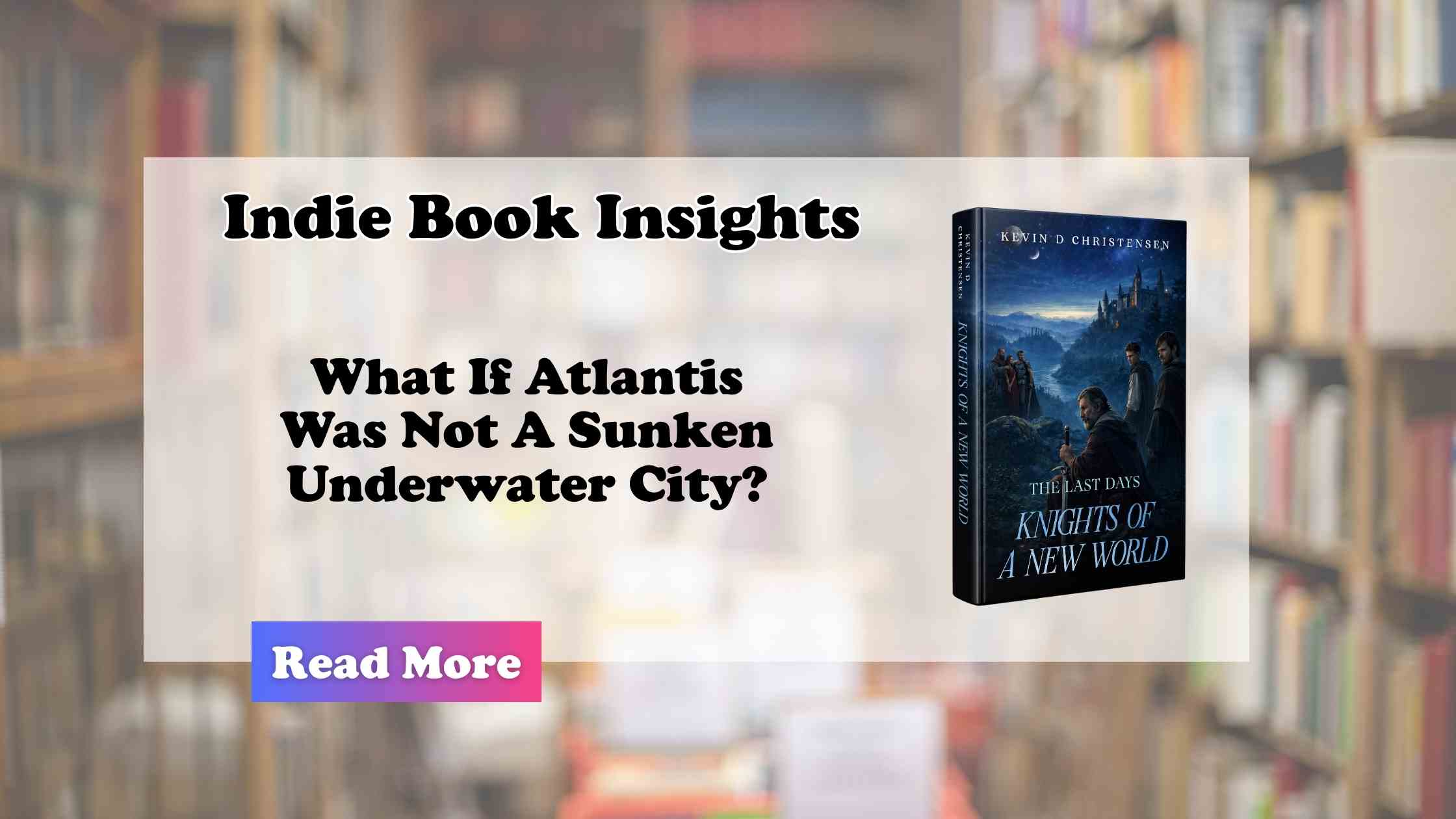
But Kevin Christensen’s Knights of A New World asks a far more thrilling question. What if Atlantis never sank? What if it survived, advanced, expanded, and became a living force in world history?
In this novel, Atlantis is not a graveyard beneath the ocean. It is a technologically superior civilisation whose reach extends into the fractured lands of post Roman Britain. The result is not a simple fantasy about a lost city, but a layered story about power, politics, faith, class, colonisation, and cultural survival.
The world of Knights of A New World opens in a Britain where ancient kingdoms, Roman authority, tribal loyalties, and spiritual beliefs still shape daily life. Around Hadrian’s Wall, places such as Northumbria, Cumberland, Carlisle, Lanercost, Hexham, Barden Mill, and Bebbanburg become more than historical settings. They become pressure points where different worlds collide.
On one side are the local people, villagers, soldiers, kings, missionaries, and tribal leaders trying to survive in a harsh and unstable age. Their world is built on physical labor, oral tradition, fear of invasion, loyalty to clan and king, and deep religious belief. To them, danger may come from soldiers, taxation, hunger, wild creatures, prophecy, or the gods themselves.
Then come the Off Landers, the Atlanteans.
They do not arrive like mythical ghosts from a ruined past. They arrive as people from a more advanced civilisation, bringing unfamiliar language, technology, political ambition, military influence, education, financial systems, and ideas that feel almost impossible to the native world. To a village blacksmith, soldier, or farmer, the Atlanteans might as well be supernatural. Their knowledge, weapons, organisation, medicine, transport, and political reach make them appear godlike, even when their motives are painfully human.
This is where Christensen’s reimagining of Atlantis becomes so compelling. Atlantis is not just a mystery. It is a power structure.
The novel uses Atlantis to explore what happens when an advanced society enters a world that is not prepared for it. The contrast is sharp and unsettling. Local kings worry about sovereignty. Villagers worry about survival. Roman officials worry about control. Political factions argue over land, industry, education, voting rights, slavery, and native protections. Meanwhile, ordinary people are caught between promises of progress and the fear that progress may simply become another form of domination.
Leia Sobek embodies much of this tension. She is educated, politically aware, and unwilling to remain silent when she sees corruption or injustice. Her questions about education, native rights, slavery, environmental harm, and political manipulation challenge the polished language of those seeking power. Through Leia, the story shows that Atlantis may be advanced, but advancement does not automatically make a civilisation moral.
That is one of the strongest ideas in the book. The Atlanteans may possess extraordinary knowledge, but they still struggle with greed, prejudice, slavery, class division, political propaganda, and imperial ambition. Their cities may be beautiful. Their institutions may be powerful. Their science may be far beyond anything Britain has seen. Yet the moral question remains unresolved: will they use their light to help others, or will they use it to cast a larger shadow?
James, Allen, and Phillip add another layer to this conflict. Their arrival among the villagers of Barden Mill reveals the human side of the cultural collision. They are strangers in a land where every word, gesture, object, and belief can be misunderstood. A guitar becomes a wonder. A simple act of protection becomes politically dangerous. Questions about weather, gods, walls, prophecy, and identity become clues to a much larger mystery.
The villagers do not merely see the Atlanteans as visitors. They see them through fear, rumor, gratitude, suspicion, and need. Some welcome their help. Others fear they have come to claim land. This uncertainty gives the story its power. The Off Landers are not treated as simple heroes or villains. They are outsiders whose presence changes everything, whether they intend it or not.
The political landscape is equally rich. The summit, the new republic, the role of the Saxons, the influence of Roman officials, and the ambitions of figures such as Gerris Joffee and General Cassian Victorious Maximus all point to a world on the edge of transformation. Britain is not only a setting. It is a prize. Land, labor, industry, faith, law, and identity are all being negotiated by people who do not share equal power.
Christensen also threads prophecy and religion through the novel in a way that deepens the uncertainty. Ancient warnings, missionary activity, imprisoned believers, the fear of Yahweh, and rumours of a warrior king all influence how people interpret events. For the native population, prophecy can be hope, fear, or guidance. For political powers, it can become something to exploit, suppress, or manipulate.
That is what makes Knights of A New World more than a speculative Atlantis story. It is a clash of civilisations told through personal stakes. The questions are not abstract. They affect villagers, prisoners, enslaved people, journalists, soldiers, mothers, children, and rulers. Who gets educated? Who gets freedom? Who controls the land? Who interprets prophecy? Who profits from progress? Who is protected by law, and who is used by it?
By moving Atlantis out of the ocean and into the machinery of empire, Christensen transforms the myth into something sharper and more urgent. Atlantis becomes a mirror for every civilisation that has ever claimed to bring progress while demanding obedience in return.
In the end, Knights of A New World reminds us that the greatest mystery of Atlantis is not whether it sank beneath the sea. The greater question is what an advanced civilisation would do if it survived. Would it guide the world toward justice, or would it repeat the same ancient patterns of conquest, greed, and control with better tools?
Kevin Christensen’s answer is complex, ambitious, and deeply thought provoking. In this reimagined world, Atlantis is not lost. It is present. It is powerful. And its greatest danger is not hidden beneath the waves, but in the choices it makes when it holds the future of other people in its hands.