
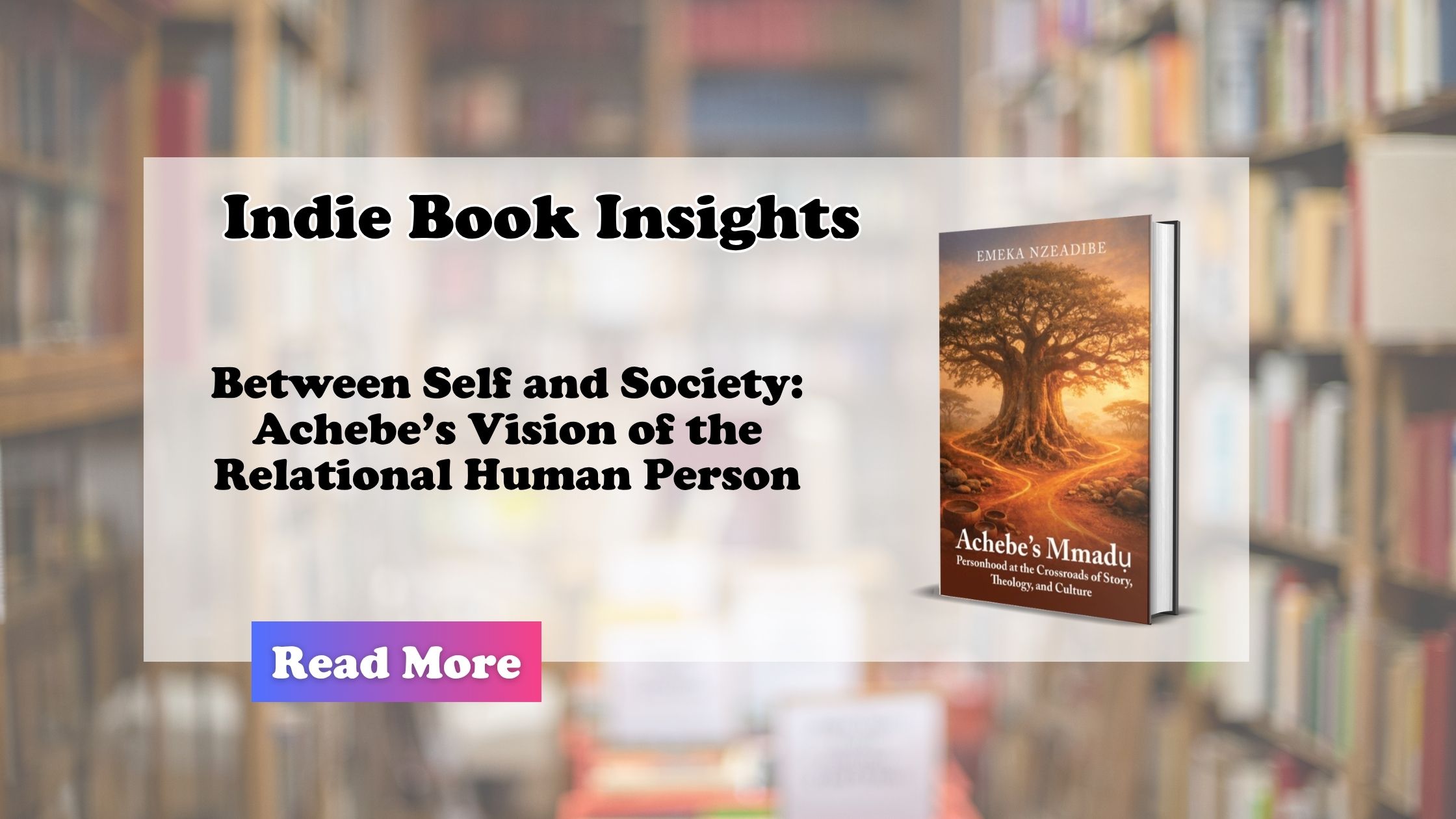
What shapes a human being more deeply: personal identity or the community to which that person belongs? Modern culture often treats these forces as opposites. Individualism emphasizes freedom, self-expression and personal ambition, while communal thinking stresses responsibility, tradition and belonging. In Achebe’s Mmadụ: Personhood at the Crossroads of Story, Theology, and Culture, Emeka Nzeadibe shows that Chinua Achebe’s literary world offers a more balanced vision, one in which the self and society remain distinct, yet inseparably connected.
At the heart of the book is the Igbo concept of Mmadụ, meaning the human person or human being. Nzeadibe presents Mmadụ not as an isolated individual, but as a person formed through relationships with family, community, ancestors, culture, the natural world and the divine. Identity emerges within this network of connections. A person becomes fully visible through participation, recognition, responsibility and interaction with others.
Yet this relational understanding does not mean that the individual disappears into the group. One of the book’s most important arguments is that Achebe’s vision avoids the simplistic choice between individualism and communitarianism. The community shapes Mmadụ, but it does not possess the final authority to erase personal identity. Each person retains an irreducible uniqueness, agency and dignity.
The concept of Chi is essential to this balance. In Igbo cosmology, Chi is closely associated with personal destiny, individuality, spiritual identity and one’s distinctive place in the world. Through Chi, every person is understood as more than a social role or reflection of communal expectations. Mmadụ belongs to the community, but also possesses an identity that can make claims beyond the collective.
Achebe’s characters make this tension vivid. Okonkwo in Things Fall Apart is deeply shaped by Umuofia’s expectations regarding strength, honor, achievement and masculinity. His public identity depends heavily on communal recognition, yet his inner fears and personal choices also drive his tragedy. Ezeulu in Arrow of God likewise stands at the crossroads of sacred responsibility, political authority, personal conviction and communal pressure. Their stories show that neither society nor the individual can be understood alone.
Nzeadibe uses these characters to ask difficult questions. What happens when social expectations become destructive? Can a person remain faithful to the community without surrendering moral judgment? And how can society preserve unity while respecting difference?
The book’s answer is relational rather than absolute. Human beings discover themselves through others, but authentic community must also protect the dignity of the individual. Mmadụ is therefore both personal and communal, self-aware and socially embedded, free yet responsible.
This vision also enters into dialogue with Christian theology. Through the idea of imago Dei, Nzeadibe strengthens the claim that every person possesses inherent worth, regardless of achievement, status, failure or social acceptance. Personhood is not something society grants as a reward. It is a fundamental reality that must be recognized and respected.
Achebe’s Mmadụ offers a timely message for a divided world. Emeka Nzeadibe invites readers to move beyond the conflict between self and society and embrace a vision of humanity grounded in relationship, freedom, responsibility and dignity. Through Achebe’s stories, the human person appears not as an isolated self or a faceless member of a group, but as someone who becomes fully human in meaningful connection with others.
Read the book on Amazon: https://a.co/d/0363OG8A