
Okay, before beginning, can we be completely honest with each other for a second? The world right now feels incredibly loud, and between the non-stop digital notifications, the pressure to constantly hustle, and the general unpredictability of daily life, finding actual inner peace can feel like trying to catch smoke with your bare hands. Right???
Many of us, most of the time, look for quick fixes. Let me guess, have you downloaded meditation apps, optimized your morning routines, or bought self-help books that tell you to just “think positive”? Even after all this, you are in the same current, and it feels like that life hasn’t changed… It is good to know that these superficial hacks don’t cure deep issues or fix your broken internal exhaustion. While they promise to be effective, only when you use these do you get to know that all of the promises were fake. And that is when you feel fragmented.
So, before you pass out, take a moment to listen up! You don’t need a productivity tip, but a philosophical anchor that completely reframes how you look at yourself and the world. Today is your lucky day. I want to share three foundational philosophical books that skip the surface-level advice and go straight to the core of lasting inner peace.
First up is a classic that has stood the test of nearly two thousand years: Meditations by Marcus Aurelius. What makes this book so extraordinary is that it was never meant to be published. It was the private journal of the Roman Emperor…Yes, the most powerful man in the world at the time. It was written to himself while fighting wars on the frontier. The core lesson of Stoicism found in these pages is that you cannot control external events, but you can entirely control your response to them. When you internalize this, a massive weight lifts off your shoulders. You stop burning energy trying to fix things outside your reach and focus completely on protecting your own character, sanity, and kindness. It is an absolute masterclass in mental resilience.
Now, if Stoicism helps you build a shield against the world, our second book helps you flow with it. I’m talking about the Tao Te Ching by Lao Tzu.
This ancient Chinese text is short, poetic, and profoundly counter-cultural. In a society that demands we constantly push, strive, and conquer, the Tao Te Ching introduces the concept of Wu Wei, or “effortless action.” It teaches us the wisdom of the water, about how it moves around obstacles without fighting them, yet eventually carves through solid rock. Reading this book is an invitation to step off the endless treadmill of comparison. It reminds us that inner peace isn’t achieved by doing more but by letting go of the need to control everything. It’s the ultimate permission slip to just be.
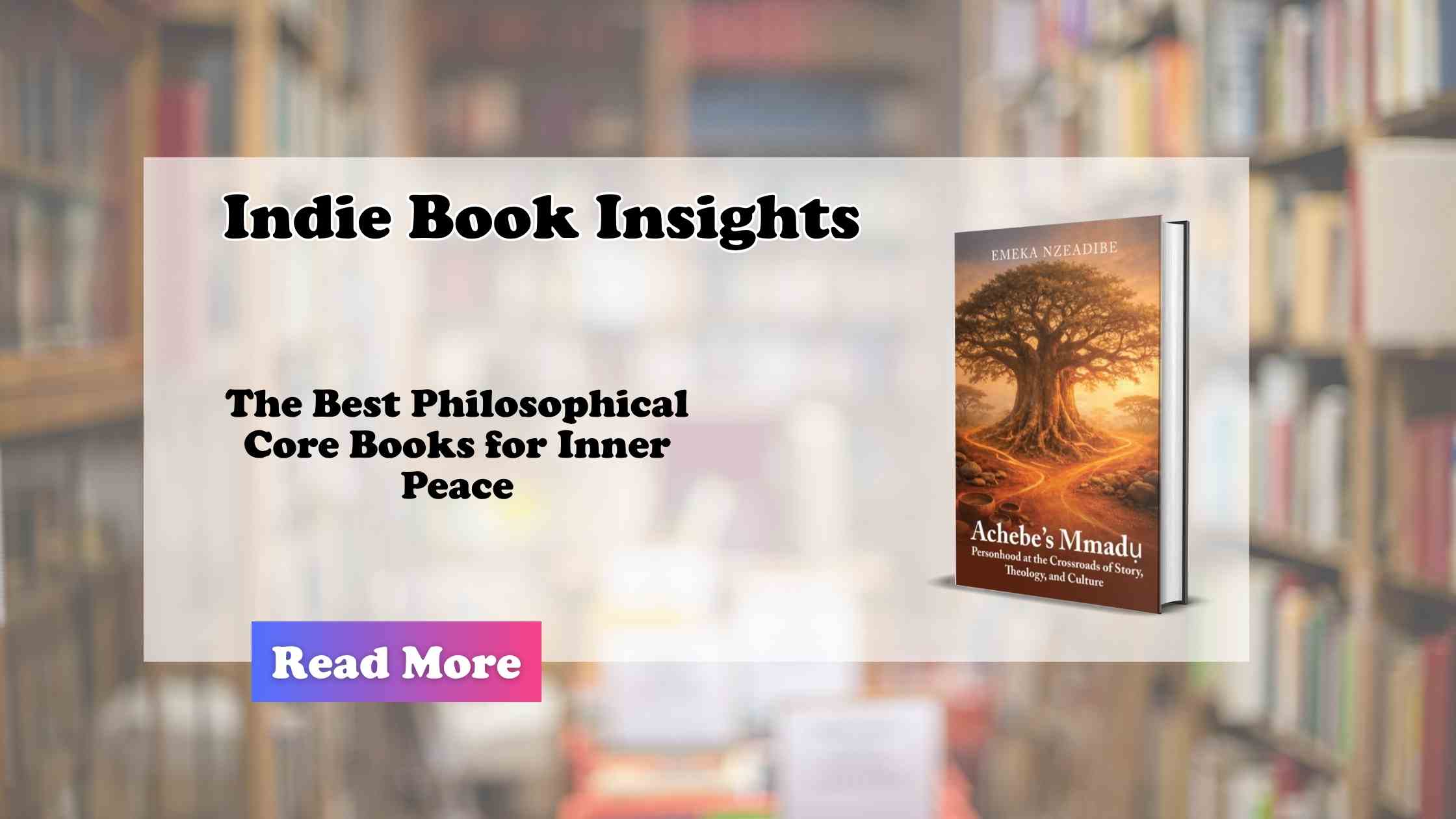
Finally, to tie everything together, we have to look at how we relate to one another. For that, you need to read Achebe’s Mmadụ: Personhood at the Crossroads of Story, Theology, and Culture by Emeka Nzeadibe.
This brilliant text dives into traditional Igbo cosmology and challenges the lonely, hyper-individualistic philosophy that dominates modern life. It introduces us to a relational model of peace. It reminds us that we aren’t isolated islands meant to carry the weight of existence all by ourselves. True, deep psychological wholesomeness comes when we realize we are interconnected with our community, our history, and the people around us. It shifts your perspective from a lonely “I am” to a grounded, peaceful “We are”.
Head to Amazon to purchase your copy: https://www.amazon.com/dp/B0GZFB5P25/
Drop a comment below and let me know which of these perspectives you need more of in your life right now. Stoic resilience, Taoist flow, or relational connection? Let’s talk about it, and don’t forget that you are not alone.