

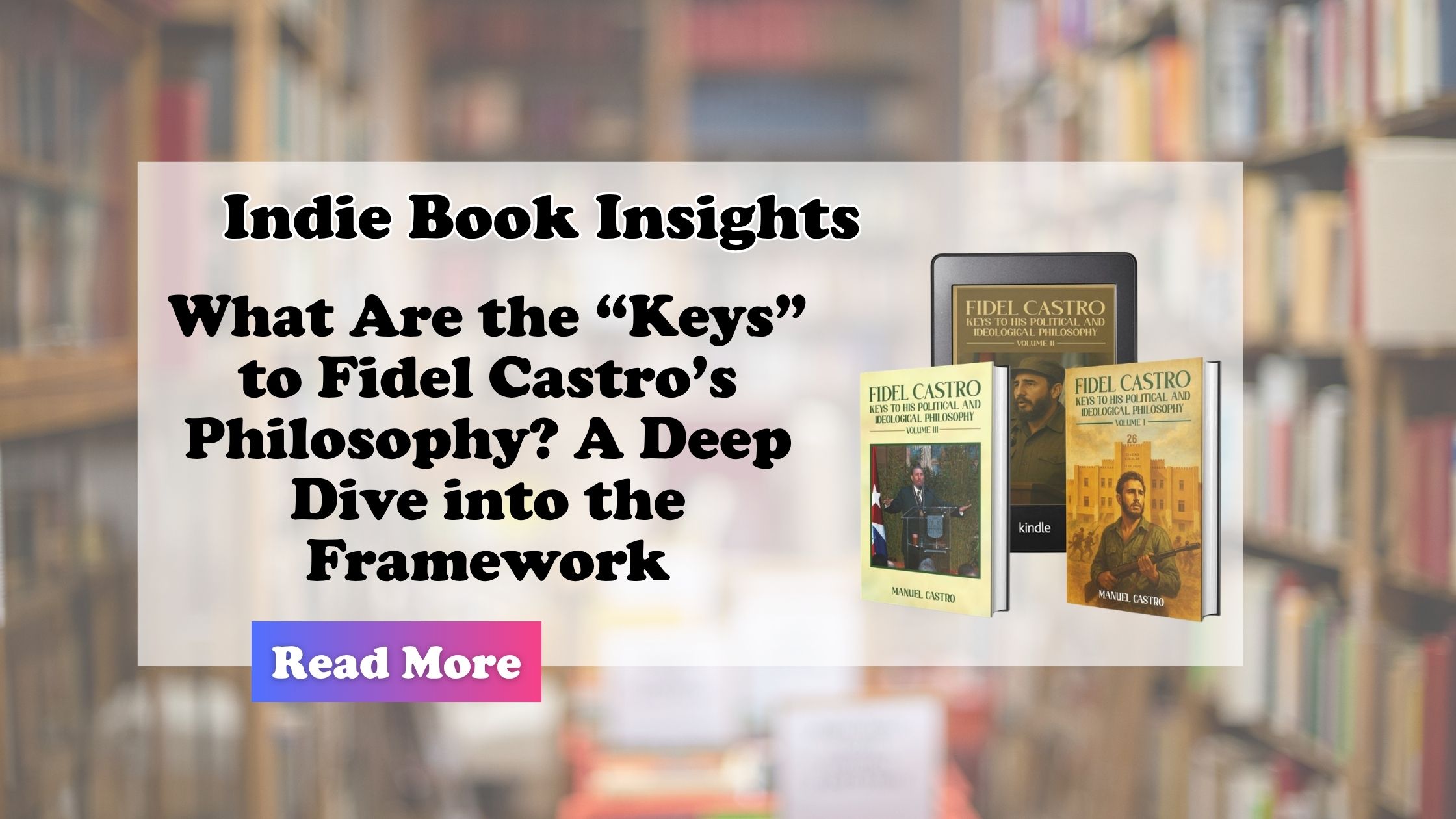
What if one of the most influential political figures of the 20th century wasn’t just a revolutionary but a systematic thinker whose ideas were carefully structured, refined and applied over decades?
That’s exactly the premise behind Fidel Castro: Keys to His Political and Ideological Philosophy (Volumes I–III) by Manuel Castro. Rather than offering a traditional biography, this three-volume work presents something far more ambitious: a conceptual map of Fidel Castro’s intellectual world.
But what exactly are these “keys”?
A Philosophy Built on Concepts, Not Just Events
Most books about Fidel Castro focus on events in the Cuban Revolution, Cold War tensions or his global influence. This series takes a different approach. It breaks down his thought into hundreds of core concepts, referred to as “variables,” each representing a building block of his broader ideology.
These include ideas like revolution, unity, sovereignty, education, ethics and internationalism. Instead of being scattered across speeches and historical moments, they are organized into a structured framework, making it easier to understand not just what Castro did, but how he thought.
This is what makes the books unique: they transform decades of speeches and actions into a coherent philosophical system.
The Core Pillars of the Framework
At the heart of this framework are several recurring themes that define Castro’s worldview:
1. Revolution as Transformation
For Castro, revolution wasn’t limited to political change. It was a comprehensive process involving social, economic, cultural and moral transformation. The books emphasize that true revolution reshapes not just institutions but people themselves.
2. Unity as Strength
One of the most consistent ideas in Castro’s philosophy is the necessity of unity. Division weakens nations; unity creates the conditions for survival and progress. This principle appears repeatedly across different contexts, politics, society and international relations.
3. Sovereignty and Resistance
A defining feature of Castro’s thought is the defense of national sovereignty. The framework highlights his persistent focus on resisting external control, particularly in the context of global power dynamics.
4. Education and Consciousness
Castro viewed education not simply as a service, but as a tool of empowerment. Raising political and social consciousness was essential for building a new society. In this sense, ideas themselves become instruments of change.
5. Ethics and Collective Responsibility
Unlike purely strategic political models, Castro’s philosophy places strong emphasis on ethical discipline, sacrifice, solidarity and collective well-being. These are not abstract ideals; they are presented as necessary conditions for sustaining any transformative movement.
Why This Framework Matters Today
At first glance, a detailed study of Castro’s ideology might seem purely historical. But the structure presented in these books makes it strikingly relevant to modern discussions.
Issues like inequality, globalization, national identity and the role of ideology in politics are still very much alive. By organizing Castro’s ideas into a clear framework, the series allows readers to engage with these questions in a deeper way.
It also challenges a common assumption: that political leaders act primarily on instinct or circumstance. Instead, it shows how a consistent set of ideas can guide decisions over time, even in complex and changing environments.
More Than a Historical Study
Ultimately, Fidel Castro: Keys to His Political and Ideological Philosophy is not just about understanding one individual. It is about understanding how ideas are formed, structured and applied in the real world.
Whether you agree with Castro’s views or not, the intellectual architecture presented in this series offers something valuable: a way to analyze political thought as a system rather than a series of isolated opinions.
And in a world where ideology continues to shape nations and movements, that kind of clarity is more relevant than ever.
If you are looking for more than surface-level history, if you want to explore the deeper mechanics of political thinking, this three-volume work provides a compelling place to start.