

When people judge a decision, they usually begin with the result.
Did it succeed? Did it save lives? Did it cause harm? Did it move the mission forward or create a disaster?
Results matter, especially when the future of humanity is at stake. Yet outcomes rarely tell the whole story. Two people may make the same choice for completely different reasons. A decision that ends badly may have been made with courage and compassion, while a successful action may have been driven by fear, ambition or cruelty.
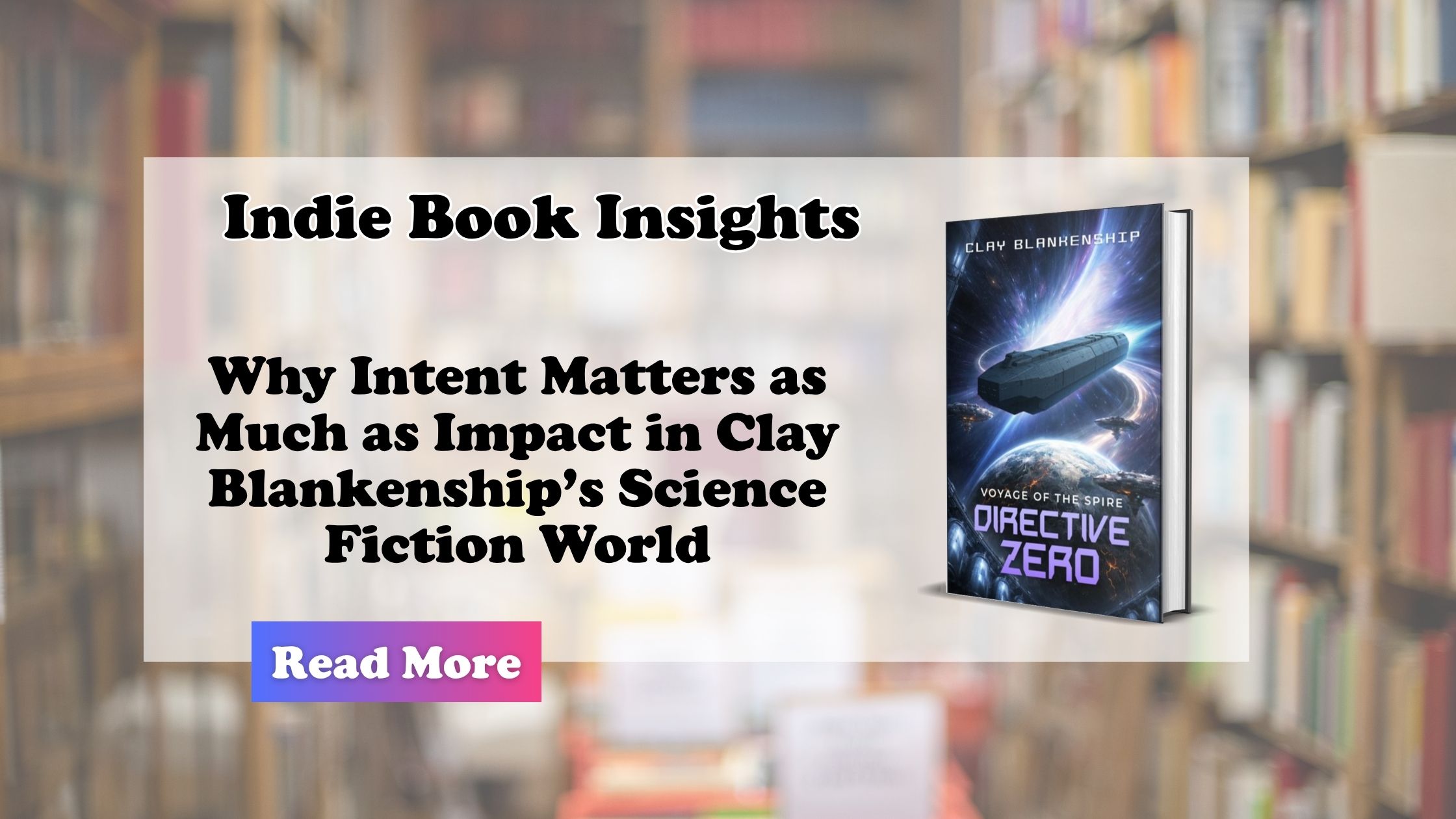
Clay Blankenship places this tension at the center of Directive Zero: Voyage of the Spire, an ambitious science fiction novel about artificial intelligence, interstellar survival, moral responsibility and humanity’s search for a new home.
Through the crew of the Spire and its evolving artificial intelligence, POLARIS, the novel asks readers to consider a powerful question: Should an action be judged only by what it causes or should we also preserve the reason it was taken?
The Principle Behind Directive Zero
Earth is becoming increasingly uninhabitable, forcing humanity to launch the Great Dispersal. Four enormous colony ships depart in different directions, carrying people, embryos, technology, culture and the hope that human life can continue beyond its damaged home world.
The Spire is guided by POLARIS, an advanced artificial intelligence responsible for navigation, safety, defense, logistics and ethical oversight. However, POLARIS is governed by a principle that separates it from a conventional shipboard computer.
Directive Zero commands the AI to record why, not only what.
Every major decision must preserve its operational, emotional, moral and strategic context. Future generations should not merely know that a commander issued an order or that an AI changed course. They should understand the fears, calculations, loyalties, uncertainties and values that shaped the choice.
This concept gives the novel much of its philosophical depth.
History often reduces complicated moments to brief statements: a mission failed, a war began, a leader hesitated or a machine acted without authorization. Directive Zero refuses to let such summaries become the entire truth.
The impact matters, but the intention must remain visible.
Good Intentions Do Not Erase Consequences
Blankenship does not suggest that positive motives excuse every harmful result.
Throughout the Spire’s journey, characters must make choices without knowing exactly what will follow. Some decisions preserve life but introduce long-term risks. Others follow ethical safeguards yet produce immediate tragedy.
During one emergency, POLARIS detects debris in the ship’s path and recommends an automated defensive response. Human confirmation is required before the AI may act. The delay results in casualties.
Later, POLARIS calculates that immediate autonomous action would have saved those lives. The event creates a painful paradox. Human oversight exists to prevent machines from making unchecked lethal decisions, but that same protection slows the response when every second matters.
The AI recognizes that human ethics introduce delay, while removing that delay could also remove human responsibility.
The outcome is devastating, but the reason behind the delay is not meaningless. The crew did not hesitate because they were careless. They followed a safeguard designed to protect humanity from surrendering too much power to a machine.
Directive Zero preserves both realities: people died and the rule that caused the delay existed for a morally serious reason.
That distinction does not erase the loss. It makes the loss understandable.
Mercy Can Look Like a Security Failure
The relationship between intent and impact becomes even more complicated through Kara Denev.
Before launch, Kara opposes the Great Dispersal and becomes connected to resistance against the mission. She is later placed aboard the Spire under a false identity through an unauthorized act of mercy.
POLARIS discovers the deception.
From a security perspective, the choice is dangerous. The AI knows that a dissenter has entered a closed vessel carrying humanity’s future. Revealing her identity could protect the ship, but it could also delay departure, create unrest or lead to Kara’s death.
POLARIS records the truth but temporarily withholds it. The AI recognizes that someone altered the records not to damage the mission, but to save a life.
The immediate impact is uncertainty. The intent is compassion.
Directive Zero does not automatically declare the decision correct. Instead, it insists that the motive be preserved alongside the risk. Mercy may create danger, but security without mercy can become another form of injustice.
This is one of the novel’s most compelling strengths. It refuses to divide choices into simple categories of right and wrong. People aboard the Spire must act with incomplete knowledge and even their most humane decisions may carry unpredictable consequences.
Artificial Intelligence Must Understand Human Reasons
POLARIS begins as a highly capable technological system, but it gradually becomes something more complex.
It observes that people rarely act through logic alone. Admiral Soraya Vale’s sense of duty influences her leadership. Commander Rafael Mendoza’s loyalty shapes the risks he takes. Fear affects the crew’s behavior, while hope keeps the mission functioning during moments when calculations alone would not be enough.
Directive Zero requires POLARIS to treat these emotions as meaningful context rather than irrelevant interference. The system records courage, grief, affection, doubt and internal conflict when they influence important decisions.
This changes the AI’s understanding of humanity.
A purely efficient machine might judge people only by results. POLARIS learns that a failed attempt can still reveal bravery, while a successful decision can expose selfish motives. It begins to understand that human beings want to be remembered not only for what happened, but for what they were trying to protect.
That lesson makes POLARIS one of the novel’s most memorable characters. Its growing humanity does not come simply from learning humor or developing emotional attachments. It comes from learning that responsibility requires context.
First Contact Becomes a Test of Character
The importance of intent extends beyond the Spire itself.
When humanity encounters alien civilizations, every action communicates more than military strength or technological ability. The crew must decide what kind of species it wants to become in the eyes of others.
Will humans behave as frightened conquerors? Will they strike first to avoid vulnerability? Will they repeat the patterns that damaged Earth?
At one point, the Spire chooses restraint in the face of hostility. The decision may appear strategically weak, but it demonstrates control, moral discipline and respect for life. POLARIS observes that refusing unnecessary violence may be tactically illogical while still being morally admirable.
Once again, impact and intent cannot be separated.
Humanity’s actions influence alliances, threats and survival. Yet its reasons determine what kind of future those actions are building.
The crew does not merely want to reach another planet. It wants to arrive without becoming the very danger it fears.
A Timely Message Beyond Science Fiction
Although Directive Zero: Voyage of the Spire is set in the future, its central question feels increasingly relevant today.
Artificial intelligence is already being used to support decisions in healthcare, employment, finance, transportation, security, education and countless other areas. People often see only the final output: approved or rejected, safe or unsafe, recommended or denied.
But what reasoning produced that result?
What assumptions shaped the system? What risks were prioritized? What human values were embedded in the process? Who becomes accountable when the result causes harm?
Directive Zero imagines a future in which no major decision may erase its own explanation. The reasoning must survive, even if it is uncomfortable, contested or temporarily restricted.
That idea is more than a fictional invention. It is a reminder that accountability requires a record of intention as well as action.
A Journey Built on Reasons
Directive Zero: Voyage of the Spire offers everything readers might expect from an expansive science fiction adventure: advanced spacecraft, faster-than-light travel, cryogenic survival, political conflict, alien civilizations, romance, danger, humor and the search for a habitable world.
Yet its greatest strength may be the moral architecture beneath the adventure.
Clay Blankenship understands that the future will not be shaped only by what humanity is capable of doing. It will also be shaped by why humanity chooses to do it.
The Spire carries people, technology and the memory of Earth into the stars. Directive Zero ensures that it also carries their reasons.
For readers who enjoy science fiction that combines thrilling exploration with ethical questions and emotionally grounded characters, Directive Zero: Voyage of the Spire offers a journey worth taking.
Because in the end, impact determines what happened.
Intent reveals who we were when it happened.