
What does it mean for something to be “real”?
Is reality only what can be seen, measured and explained? Or can memory, belief, spiritual experience and personal perception reveal truths that ordinary logic cannot fully capture?
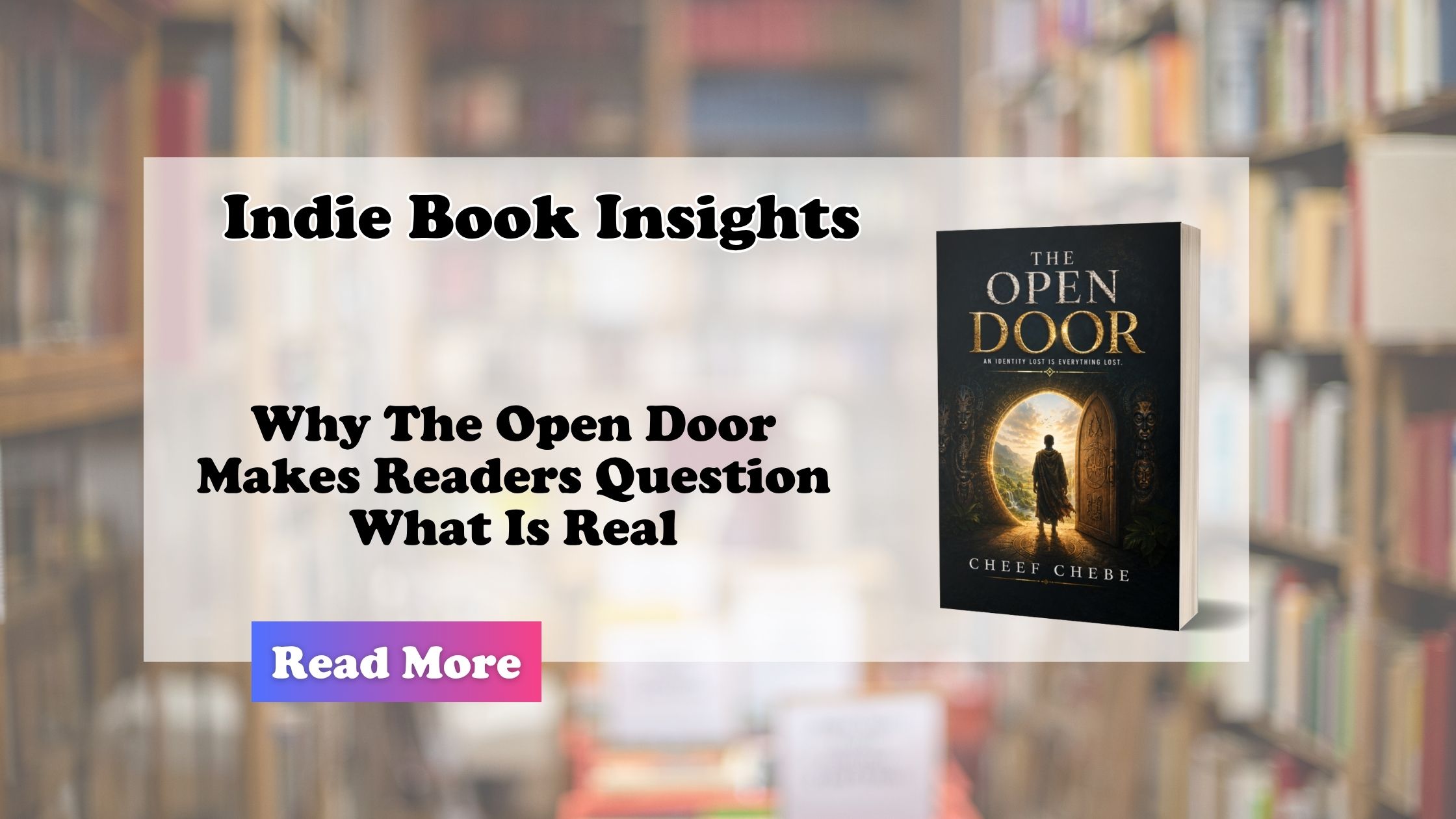
Those questions run throughout The Open Door by Cheef Chebe, a genre-blending story that constantly invites readers to reconsider the boundaries between the familiar and the impossible.
From its opening pages, the book refuses to offer easy certainty. Djambay awakens in a strange treehouse with little memory of who he is, where he came from or why invisible voices seem to know him. Instead of receiving simple answers, he finds himself drawn into an increasingly unusual world of reincarnation, spiritual dimensions, ancestral memory and mysterious guides.
The result is a story where reality is never quite as straightforward as it first appears.
Memory Becomes Part of the Mystery
One of the strongest sources of uncertainty in The Open Door is Djambay’s fragmented memory.
As pieces of his past return, he begins remembering another identity: Dr. Peter Morgan, a man who lived in Glasgow. Familiar places, relationships and experiences slowly come back into focus, yet they exist alongside a new reality that seems to challenge everything he once believed.
Was his former life the complete truth? Is his present existence another level of reality? And how much can memory be trusted when identity itself is changing?
Chebe uses those questions to keep readers thinking beyond the immediate plot.
Spiritual Experience Meets Modern Definitions
The book becomes even more thought-provoking when Djambay’s experiences intersect with ideas about mental health and social judgement.
Invisible voices, unusual perceptions and supernatural encounters could be interpreted very differently depending on who is observing them. Within the narrative, those experiences become part of a wider exploration of how societies define what is normal, abnormal, believable or impossible.
Rather than offering a simple medical or spiritual conclusion, The Open Door turns that tension into part of its philosophical landscape.
Readers are encouraged to consider how easily one person’s deeply meaningful experience can appear unbelievable to someone else.
Familiar Places Become Unfamiliar
Even Glasgow, one of the story’s most recognizable settings, takes on a strange new quality.
Djambay returns to a city connected to his former life, yet he does so as someone who has already been told that the person he once was is dead. Familiar streets and people therefore become part of an unsettling puzzle.
Then the story moves even further from ordinary reality through Ambatonia, the City of Light, spiritual travel, unusual beings and ideas about multiple dimensions.
Chebe constantly shifts between recognizable reality and imaginative possibility.
The Real Question May Be About Ourselves
Ultimately, The Open Door does more than ask whether its extraordinary events are “real.”
It asks readers to think about how reality itself is shaped by culture, memory, belief, identity and perspective.
Two people can experience the same world differently. One generation may dismiss knowledge another considers sacred. One society may label an idea impossible while another sees it as fundamental.
That is what makes Cheef Chebe’s story so intriguing.
Behind the reincarnation, mystery, satire and spiritual adventure lies a deeply human question: How certain are we that the version of reality we accept is the only one possible?
For readers who enjoy stories that challenge assumptions while exploring identity, African cultural heritage, faith, consciousness and modern society, The Open Door offers an imaginative journey filled with questions worth carrying beyond the final page.
Read the book on Amazon: https://www.amazon.com/dp/B0HKXFPZLN/