

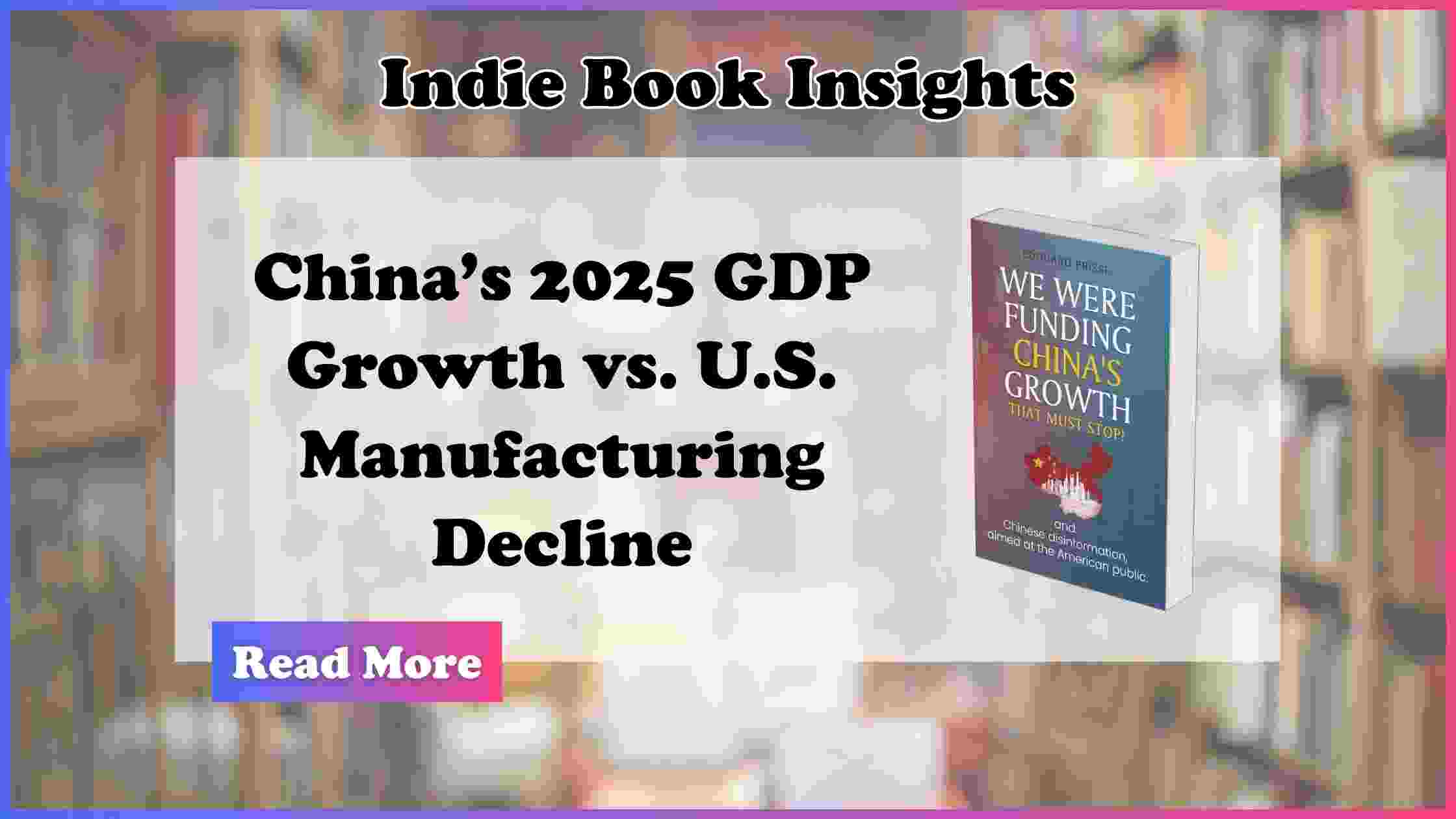
As we enter the second half of 2025, one economic contrast stands out like a flashing warning light. That is, the economy of China is still expanding steadily, whereas manufacturing in the United States is still declining. It’s more than an economic split. It’s the result of two decades of strategic errors that Edouard Prisse breaks down in We Were Funding China’s Growth That Must Stop!.
Let’s start with the numbers.
According to China’s National Bureau of Statistics, China’s GDP is projected to grow by 5.2% in 2025, despite global slowdowns. Meanwhile, the U.S. is seeing a decline in its manufacturing output, with data from the Federal Reserve indicating a year-on-year drop of 2.3% in U.S. manufacturing production as of Q2 2025. The Institute for Supply Management (ISM) reports that the Manufacturing PMI has remained below 50, the contraction threshold, for 10 consecutive months.
This widening gap reflects a deeper imbalance created by years of flawed trade policy. Since China’s WTO accession in 2001, Western economies, especially the U.S., have outsourced production en masse to China, attracted by low wages and flexible regulations. What they ignored was the long-term hollowing out of their own industrial bases.
Prisse highlights this as the central tragedy of the past two decades. “The West,” he writes, “chose cheap goods over strategic independence.” That choice is now bearing bitter fruit.
China, in contrast, has played the long game and is winning it. For example, it reinvests trade surpluses into industrial capacity, technology, and global infrastructure projects. While U.S. factories close, China opens new ones. And while American policymakers debate whether reshoring is even possible, China’s central planners are securing dominance in fields like green tech, artificial intelligence, and semiconductors.
What’s more alarming is that this trend continues with little resistance. Although political leaders speak of “decoupling” and “strategic competition,” U.S. imports from China still totaled $418 billion in 2024, according to the U.S. Census Bureau. That’s only a minor drop from previous years, proving that rhetoric isn’t translating into reality.
Meanwhile, the once-mighty American manufacturing sector now contributes only about 11% of U.S. GDP, down from 16% in 2000. Moreover, Germany’s industrial base, formerly Europe’s economic engine, is also faltering under Chinese pressure. As Prisse bluntly notes, “What we see now is only the beginning.”
So, where do we go from here?
Prisse argues for a complete shift to regulated trade, not isolationism, but reciprocity. The solution is not small tariffs or superficial trade wars. Rather, there needs to be a real, equitable realignment of value, where we import only as much as we export. This won’t just help workers but also will save Western sovereignty, and most importantly, the U.S., from decline.
We should stop funding China’s growth and free trade policies. Otherwise, we risk watching China’s GDP soar while our factories stand silent, which will eventually lead to our breakdown.
For more information and insight, please read We Were Funding China’s Growth That Must Stop!. Order your copy on Amazon: https://www.amazon.com/dp/1967963053.