We use the phrase “lost cause” far too easily.
It shows up in quiet conversations and official reports alike, used to describe people who have fallen too far, failed too often or broken in ways that seem irreversible. It’s a label that sounds final, almost clinical. Efficient. Clean.
But what if it’s wrong?
What if no one is ever truly a lost cause, only misunderstood within systems that were never designed to understand them?
The idea of a “lost cause” says more about the system than the individual. It reflects a framework that prioritizes order over humanity, compliance over complexity. In such systems, anything that cannot be quickly measured, categorized or fixed becomes a liability. And when a person doesn’t respond to standard solutions, the system doesn’t adapt its labels.
Case closed.
But human beings are not case files. They are not static problems waiting for a standardized solution. They are dynamic, adaptive systems capable of collapse, yes, but also capable of recovery, reinvention and transformation.
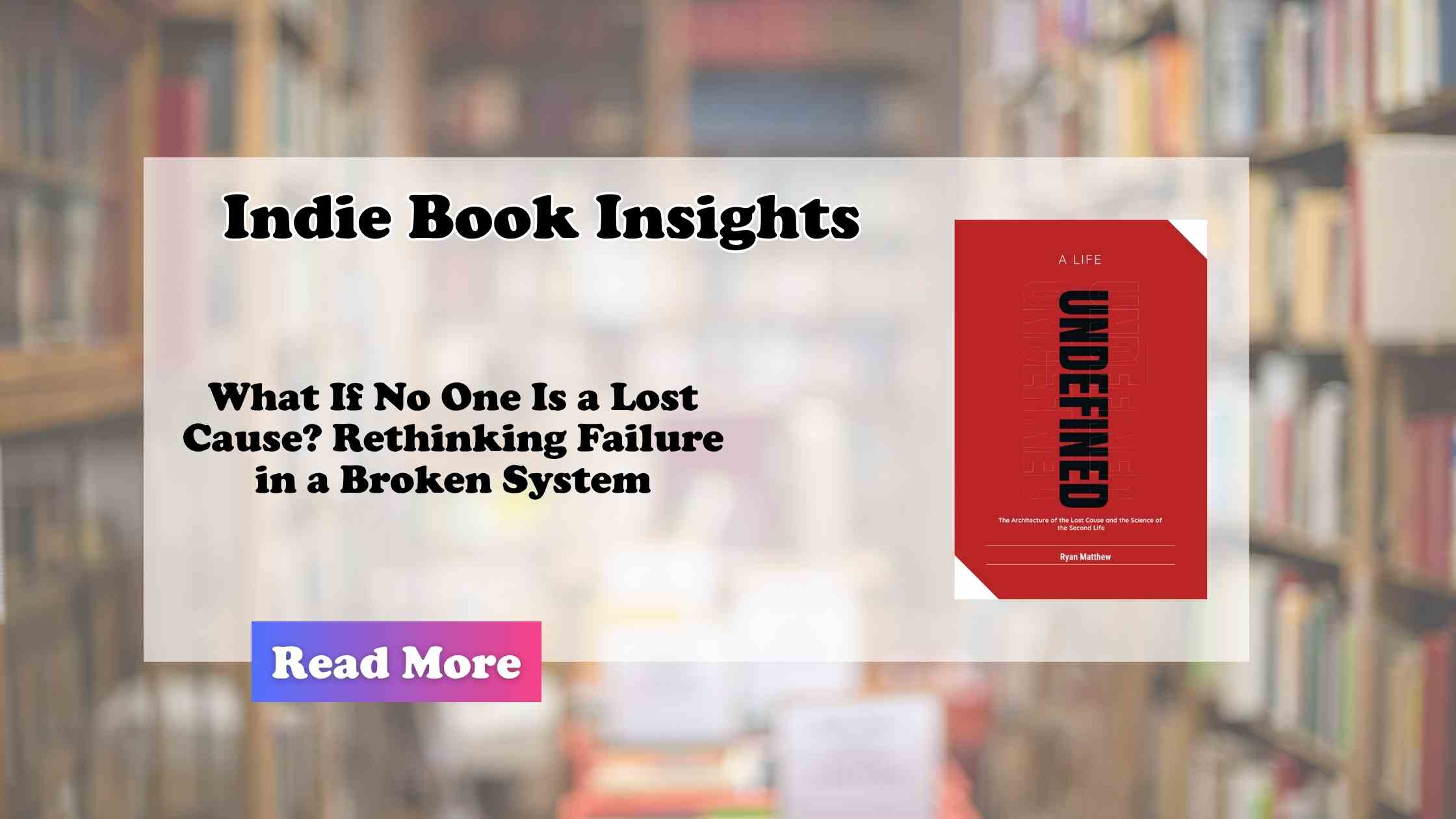
This is the central premise behind A Life Undefined: The Architecture of the Lost Cause and the Science of the Second Life by Ryan Matthew, a book that challenges one of the most dangerous assumptions we carry: that some people are beyond saving.
Drawing from his own experience in high-pressure law enforcement and personal collapse, Matthew reframes failure not as an endpoint, but as a transition point. What looks like a breakdown is often a system overload, a moment where the individual’s internal resources are overwhelmed by external demands, trauma or invisible pressures.
In that moment, the label “lost cause” is applied not because the person is beyond recovery, but because the system has reached the limits of its imagination.
And that’s where the real problem lies.
When we define people by their worst moment, we strip them of their potential. We reduce complex human experiences into fixed identities. And perhaps most dangerously, we remove the possibility of a “second life,” a chance to rebuild, redefine and reclaim control.
Matthew introduces a different approach, one rooted in self-definition and recovery. Instead of asking, “What’s wrong with this person?” he invites us to ask, “What happened and what’s still possible?”
It’s a subtle shift, but a powerful one.
Because when you stop defining yourself or others by failure, you open the door to something else entirely: agency.
Recovery doesn’t begin with fixing. It begins with recognizing that the person in front of you is not the problem; they are a system under pressure. And systems can be recalibrated.
Sometimes, it starts with something as simple as a breath.
In A Life Undefined, Matthew introduces practical frameworks, such as the “BREATHE” model, a method designed to help individuals regain control in moments of crisis. It’s not about a dramatic transformation. It’s about small, deliberate actions that restore autonomy and interrupt the spiral of collapse.
One decision. One shift. One breath at a time.
The truth is, the concept of a “lost cause” is comforting because it allows us to stop trying. It creates distance between “us” and “them.” But it also blinds us to the reality that, under different circumstances and with different support, anyone could find themselves on the same edge.
So what if we let go of that label?
What if, instead of writing people off, we rewrote the narrative?
Because maybe the question isn’t whether someone is a lost cause.
Maybe the question is whether we’re ready to see them differently.
And in doing so, allow them to see themselves that way too.
A Life Undefined isn’t just a book; it’s an invitation to rethink failure, reclaim identity and recognize that every ending holds the blueprint for a second life.
Available On Amazon: https://www.amazon.com/dp/B0H1GXHFVL/