
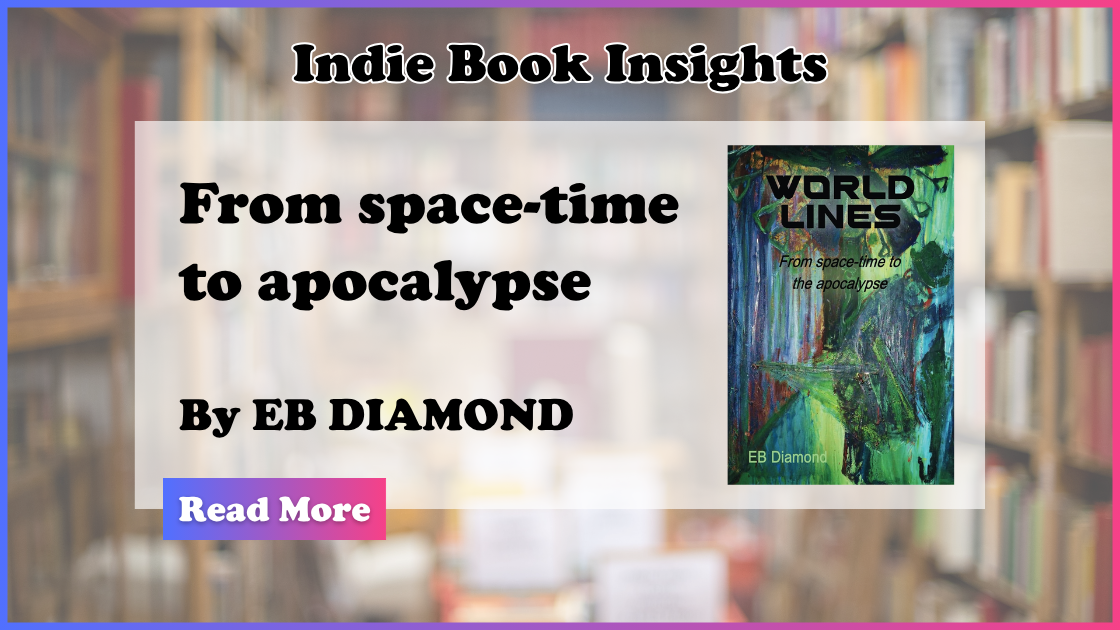
“World Lines” and the Cosmic Alternative to Survival Bunkers
In EB Diamond’s World Lines, the end of the world is not only inevitable—it’s predictable. But rather than respond with doomsday prepping or militaristic retaliation, Professor Sloan offers a far more audacious plan: don’t fight the apocalypse—leave it. Not by spaceship, not by bunker, but by shifting one’s position in space-time. A daring theoretical physicist, Sloan believes that instead of physically surviving disasters, the key to human endurance lies in following a different world line.
In the novel, a “world line” is a trace of a person’s or object’s path through space-time. Most humans, Sloan explains, follow straight lines: born at point A, die at point B, moving inexorably forward. But some—called “Alternates”—curve, loop, or cross axes multiple times, allowing them to disappear from one location and reappear in another, possibly another time, dimension, or even reality. These aren’t science fiction inventions alone—they’re rooted in Einsteinian thought, with wormholes and time dilation providing plausible scientific metaphors.
Sloan’s core hypothesis is that extinction can be sidestepped, not prevented, if we learn how to navigate these alternate paths. It’s not about cheating death but about redefining what survival means. In one stunning passage from the introduction, the narrator posits that the ancients—those mysterious civilizations we can’t quite explain—may have survived past cataclysms by doing just this: “altering their World Lines along the time or space axis so that they simply escaped a cataclysm by appearing in a different spatial position at the same time or in a different era at the same position.”
This idea underpins Sloan’s entire life’s work. It also explains why the novel focuses so heavily on symbolic locations—like the neutrino mine in Canada and the Queen’s Chamber in the Great Pyramid of Giza. These sites aren’t just backdrops. They’re potential points of vulnerability—places where world lines can bend due to the concentration of cosmic forces like gravity, electromagnetic radiation, or, as Sloan postulates, the presence of an “Alternate” being.
In one comically sobering exchange, Marco Spelling—the capitalist behind the neutrino mine—mockingly summarizes Sloan’s ambition: “Sort of close the door, open the window type thing… Let a few lucky souls escape to the past while the rest of the world is annihilated.” And while the sarcasm is thick, the stakes are real. If an extinction-level event is truly imminent, what better strategy than finding a cosmic exit ramp?
It’s a profound rethinking of survivalism. Rather than burrowing underground or blasting off into space, Diamond’s characters propose escaping into possibility itself. Sloan argues that these departure points might even have been marked historically—as burial sites, religious shrines, or ancient monuments. “Isn’t it logical to mark a position where someone has disappeared with a monument?” he asks. The implication? Humanity has already used this strategy—just not in the linear history we remember.
Still, the novel doesn’t suggest this is a practical plan. The question is whether it’s possible, not how to do it. The experiment—built from a bedroom reconfigured to match the dimensions of an Egyptian chamber—is a prototype, a thought experiment as much as a physical one.
Ultimately, World Lines asks us to imagine that extinction isn’t a wall, but a fork. One world line leads to destruction; another leads somewhere else—somewhen else. Sloan may be dismissed by his peers as eccentric or even mad, but he’s betting on a truth that transcends our linear thinking: survival may not come from resisting fate, but by rerouting it.
In an age of real-world threats—climate collapse, war, pandemics—EB Diamond offers an unorthodox proposition: if we can’t change what’s coming, maybe we can change where we meet it. Or better yet, skip it entirely.