


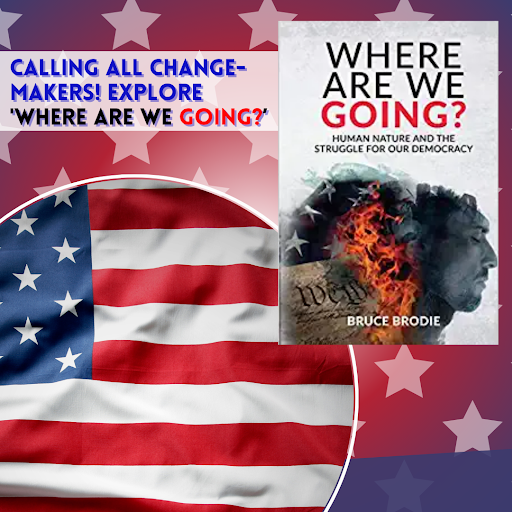
In the book “Where Are We Going?“ author Bruce Brodie presents an existential struggle between democracy and autocracy, which is driven by the growing inequalities in income and wealth and persistent racial inequities in America. This struggle has divided the country, polarized politics, and unleashed our tribal instincts. Our hybrid human nature is partly selfish and partly altruistic, partly hierarchical/authoritarian and partly egalitarian and tribal. The question is, is our hybrid human nature compatible with egalitarian democracy? In this blog, we will explore the concept of egalitarian democracy and how our hybrid human nature impacts our ability to achieve it.
Egalitarian democracy is based on the principles of equality and liberty, where everyone is equal before the law and has the right to participate in the decision-making process. This idea is based on the belief that every individual has the right to pursue happiness and lead a fulfilling life. Egalitarian democracy is not just about individual rights and freedoms; it is also about promoting the common good and ensuring that everyone has access to the resources they need to live a good life.
However, our hybrid human nature poses a challenge to the achievement of egalitarian democracy. Our tribal instincts are deeply ingrained and activated in situations of scarcity, uncertainty, and threat. These instincts drive us to form groups that exclude others and to identify with those who are like us, leading to the formation of tribes. Tribalism is not compatible with egalitarian democracy, as it is based on the principles of hierarchy and exclusion, where some people are more important than others, and some people are excluded from the group.
To overcome tribalism, we need to change our cultural environment. We need to create a culture that values cooperation, empathy, and understanding and recognizes our interdependence. Brodie suggests that we need to reduce economic and racial inequities, achieve new attitudes and perspectives, and restore the American Dream that allows us to rise from the depths of poverty to social and economic success through hard work and perseverance.
Reducing economic and racial inequities is not just a moral imperative but also a practical necessity. Economic and racial inequities are unfair; they create social divisions and undermine social cohesion. When people feel that they are being left behind, they become resentful and angry, and they are more likely to embrace extreme ideologies that promise to restore their lost status. To achieve a more egalitarian society, we must adopt new attitudes and perspectives recognizing our interdependence. We need to understand that we are all part of a larger community and that our well-being depends on the well-being of others.
Another challenge to achieving egalitarian democracy is the issue of trust. Trust is the foundation of any democratic society; without it, democracy cannot function. However, our hybrid human nature makes it difficult to trust others. Our tribal instincts make us wary of people who are not like us, and we are more likely to trust people who are part of our own group. This creates a situation where people are divided and do not trust each other. To build trust, we need to create spaces where people from different backgrounds can come together and get to know each other. We need to encourage dialogue, empathy, and understanding and foster a sense of common purpose.
Brodie argues that to achieve egalitarian democracy, we need to restore the American Dream. The American Dream is the idea that working hard can achieve success and upward mobility. This dream has been fading away in recent years as economic and racial inequities have grown and social mobility has declined. To restore the American Dream, we need to invest in education, job training, and infrastructure and create an economy that works for everyone.
One way to achieve this is through policies that promote economic equality. This includes raising the minimum wage, ensuring that everyone has access to affordable healthcare and education, and providing a social safety net for those who fall behind. It also means creating a tax system that is fair and progressive, where the wealthy pay their fair share, and everyone has access to the same opportunities.
Achieving egalitarian democracy is not easy, but it is essential if we want to create a society that works for everyone. Our hybrid human nature presents a challenge, but it is not insurmountable. By reducing economic and racial inequities, adopting new attitudes and perspectives, building trust, and restoring the American Dream, we can create a culture that values cooperation, empathy, and understanding and recognizes our interdependence. Only then can we achieve a truly egalitarian democracy.
In conclusion, Bruce Brodie’s book “Where Are We Going?“ presents an important question about the compatibility of our hybrid human nature with egalitarian democracy. While our tribal instincts present a challenge, it is not insurmountable. By reducing economic and racial inequities, adopting new attitudes and perspectives, building trust, and restoring the American Dream, we can create a culture that values cooperation, empathy, and understanding and recognizes our interdependence. Only then can we achieve a truly egalitarian democracy that promotes the common good and ensures everyone has access to the resources needed to live a good life.