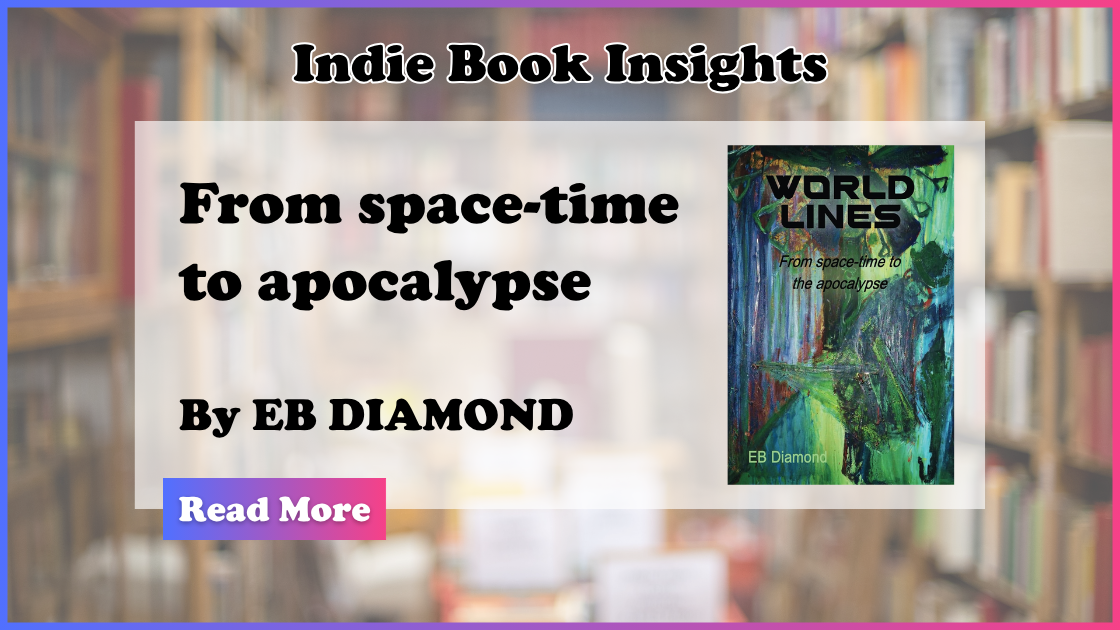
Exploring Fate and Choice in EB Diamond’s “World Lines”
In EB Diamond’s World Lines, time is not a one-way street. It’s a map—full of loops, forks, and unexpected intersections. But what does that mean for the people walking those lines? Are they free to choose their paths, or are they simply following routes already drawn?
This central tension—between free will and determinism—runs like a hidden current through the novel’s humorous, mind-bending narrative. Professor Sloan, the eccentric physicist at the story’s core, believes that most people follow a “normal” world line: a straight trajectory from birth to death, never straying. But the rare few—the “Alternates”—break the mold. They cross axes, revisit points in time, and slip in and out of our dimension. These individuals are anomalies, but they offer a radical possibility: that destiny might be reversible, or at least reroutable.
Sloan’s diagrams show these paths crisscrossing space-time, with certain junctures—like the Great Pyramid’s Queen’s Chamber or the neutrino mine in Canada—acting as forks in the road. These locations, he suggests, may offer points of access where a person can leap from one trajectory to another. It’s not teleportation—it’s a change in direction. In his own words, “Isn’t it logical to mark a position where someone has disappeared with a monument?”
The idea is both elegant and terrifying: if there are forks in the world line, then every moment might be a choice, even if we don’t recognize it. But not everyone gets to choose. In fact, most characters in World Lines seem trapped by the same limitations as the rest of us—bounded by routine, obligation, and disbelief.
Take TD1 and TD2, the reluctant neutrino monitors. They spend their days in a half-dreaming state, absorbing subliminal flashes of ghostly visions in the reflective pool. They don’t act on these visions. They barely understand them. For them, the idea of changing destiny is both too vast and too vague. They represent the majority—those whose paths are straight not by fate, but by inaction.
But others in the story—Darien Sloan, for instance—embody active resistance. As an Air Force pilot, she refuses to accept the disappearance of graduate student Richard Watson, even when told the evidence is inconclusive. She disobeys orders, crashes behind enemy lines, and endures captivity. She does not follow a line—she draws one. Though not explicitly “Alternate,” Darien’s actions suggest that agency is alive and well, even in a world governed by probability and physics.
Professor Sloan himself is perhaps the most complex figure in this debate. On one hand, he’s driven by destiny—haunted by a vision of mass extinction, he’s obsessed with building a portal in his home to escape. But on the other hand, his refusal to accept the consensus of the scientific community—his willingness to test new hypotheses, even when ridiculed—reveals an unshakable belief in choice. He does not wait for fate; he attempts to rewrite it.
Still, the novel stops short of offering a final answer. Sloan’s theories remain unproven. Watson’s fate is unresolved. The world may end—or it may not. In that uncertainty lies Diamond’s deepest insight: perhaps it’s not about whether the future is fixed, but about whether we’re willing to challenge it.
In the end, World Lines doesn’t claim that destiny is written in stone. It suggests something more radical: that destiny may be written in chalk—and that each of us holds the eraser.