

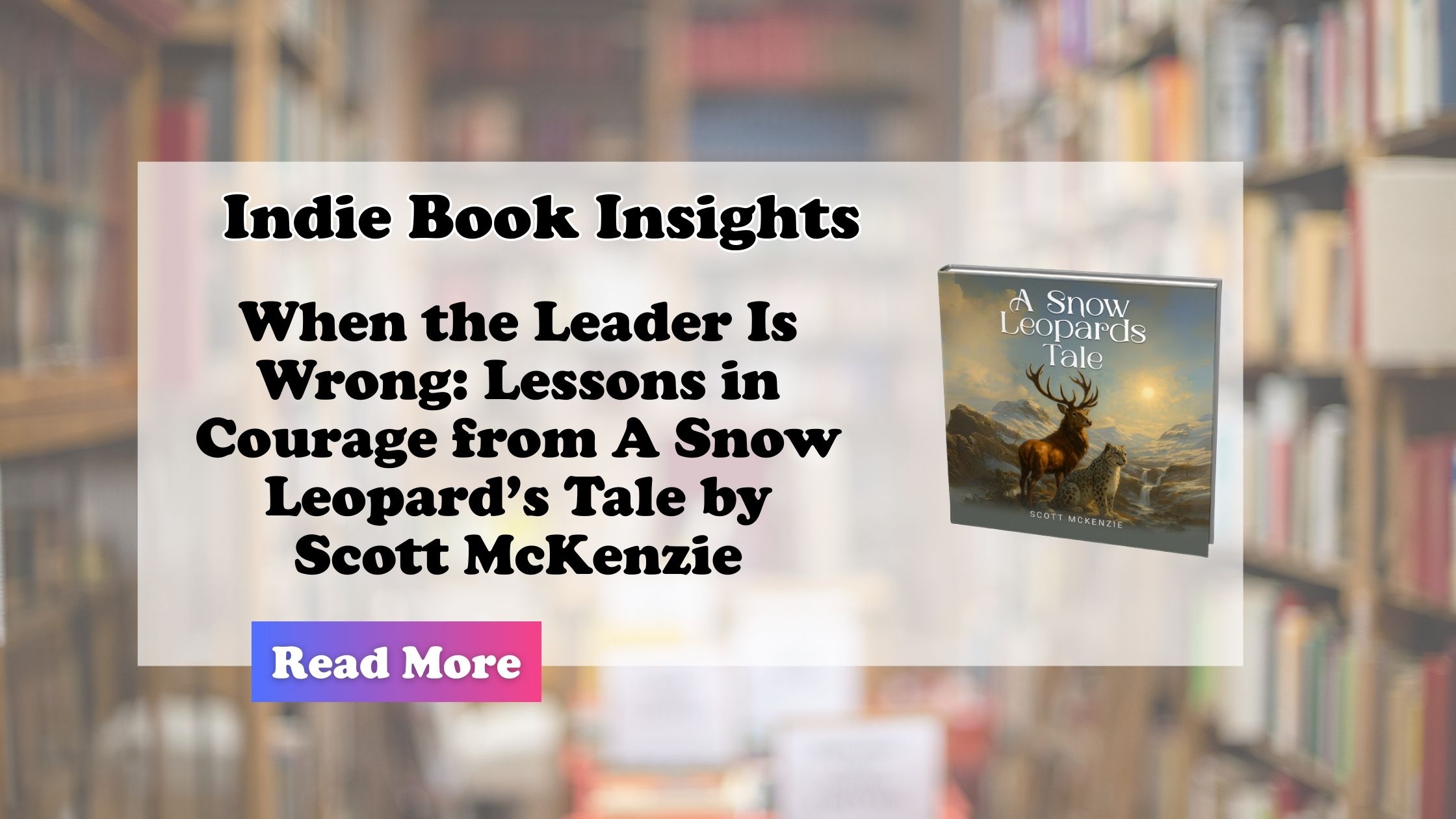
Leadership is often associated with certainty. A leader is expected to protect, decide, and guide without hesitation. But what happens when a leader makes the wrong call? More importantly, what happens when those who follow must decide whether to remain silent or speak up? In A Snow Leopard’s Tale by Scott McKenzie, this tension becomes one of the story’s most powerful themes.
Dileas, the respected leader of the Highlands, carries authority and responsibility. His decisions shape the safety of his land and its animals. When Brave, an outsider and a snow leopard, enters the Highlands, suspicion spreads quickly. Brave is different, powerful, and unfamiliar. To Dileas, he represents risk. Protection of the community becomes his priority, and fear begins to influence judgment.
The complexity lies in the fact that Dileas is not cruel. He is cautious. He is protective. Yet protection without full understanding can become injustice. Brave has already saved Logan’s life from poachers, but that truth struggles to outweigh perception. The leader’s assumption that Brave is dangerous sets in motion conflict that threatens to fracture trust and unity.
Logan stands at the heart of this moral crossroads. As Dileas’s son, he is expected to honor and obey his father. Instead, he chooses to defend Brave. He openly accepts that he will face his father’s anger for disobedience. That decision requires extraordinary courage. Speaking against authority is never easy, especially when that authority belongs to a parent and a respected leader.
Scott McKenzie carefully shows that courage is not limited to battle scenes. It appears in conversations, in choices made quietly, and in loyalty rooted in truth. Logan’s bravery is not about defeating enemies. It is about standing firm when the easier path would be silence. He recognizes that leadership can falter, and he understands that justice sometimes requires challenging those at the top.
The manipulations of Gruff and the Wilds intensify this lesson. Gruff deliberately plans to frame Brave, knowing that Dileas’s fear will make the accusation believable. By exploiting existing bias, he demonstrates how quickly a leader’s misjudgment can be weaponized. When leadership is clouded by assumption, it becomes vulnerable to manipulation.
The story does not present rebellion as reckless defiance. Instead, it presents moral courage as thoughtful and principled. Logan does not seek to undermine his father’s authority. He seeks fairness. His actions suggest that true loyalty is not blind obedience. It is commitment to truth and integrity, even when uncomfortable.
There is also a deeper leadership lesson embedded within Dileas’s journey. Strong leaders must be willing to reassess. Authority does not guarantee infallibility. The ability to listen, to reconsider, and to admit error may be the most powerful trait of all. In this way, the story challenges both young readers and adults to reflect on the balance between protection and prejudice.
The Highlands setting amplifies this theme. In a harsh landscape where survival depends on unity and wisdom, misjudgment carries real consequences. Fear based decisions can fracture alliances. Trust must be carefully maintained. Leadership in such an environment demands not only strength, but discernment.
For young readers, the message is clear and relevant. There may be moments when teachers, parents, or peers are wrong. Responding with disrespect is not the lesson. Responding with courage, honesty, and integrity is. Standing up for someone who is misunderstood may carry personal cost, but it also defines character.
When the leader is wrong, the easy response is silence. A Snow Leopard’s Tale by Scott McKenzie shows a different path. It teaches that true courage sometimes means challenging authority with respect and conviction. Leadership may guide the group, but conscience guides the individual. When both align, communities thrive. When they conflict, courage determines the outcome.
Available Now On Amazon: https://www.amazon.com/dp/B0GNHQ3CPR/