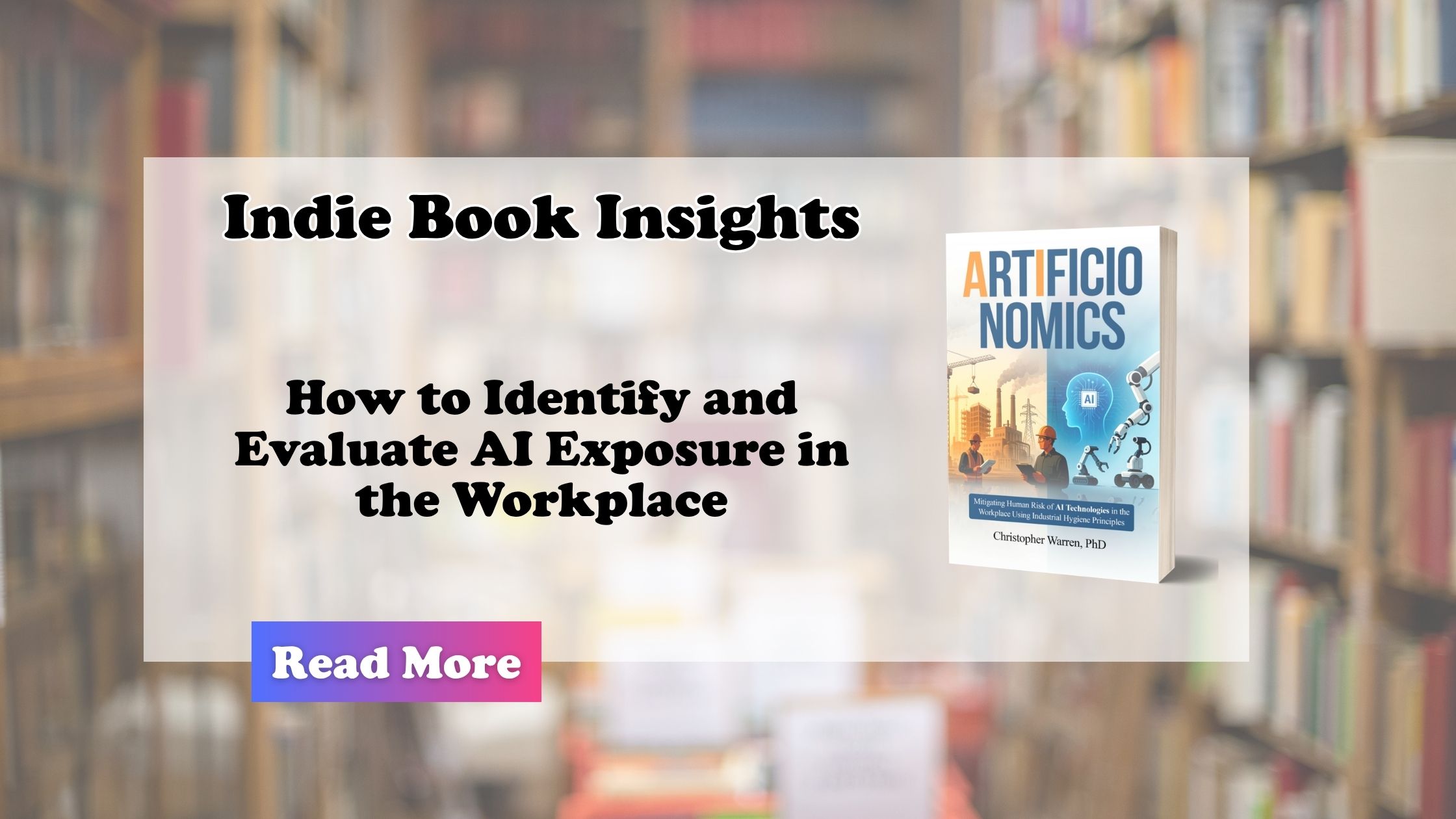
Artificial intelligence is now part of everyday work. It helps companies manage schedules, analyze data, monitor productivity, support customer service, guide hiring, improve safety and even operate robotics in physical workspaces. While these tools can make organizations faster and more efficient, they also create new forms of exposure that many businesses have not yet learned how to measure.
That is why ArtificIonomics: Mitigating Human Risk of AI Technologies in the Workplace Using Industrial Hygiene Principles by Christopher Warren, PhD is such an important book for the modern workplace. Dr. Warren presents AI not only as a technological advancement, but also as a workplace health and safety concern. His book gives leaders, safety professionals and organizations a practical way to identify, evaluate and control the human risks that may come with AI adoption.
In traditional industrial hygiene, exposure often refers to contact with hazards such as chemicals, noise, heat, radiation, poor ergonomics or unsafe machinery. These risks can usually be observed, measured and controlled through established safety methods. AI exposure is different. It may not always be visible. It may appear through constant surveillance, algorithmic pressure, cognitive overload, reduced autonomy, emotional fatigue, privacy concerns or mistrust in automated decisions.
For example, an employee working under an AI productivity system may not face a physical hazard in the traditional sense. However, that worker may experience stress from being constantly measured and monitored. A customer service employee using AI-generated scripts may feel less control over personal judgment. A warehouse worker moving around autonomous robots may face both physical and psychological pressure. A manager relying on predictive analytics may feel uncertain about when to trust the system and when to challenge it.
ArtificIonomics helps organizations recognize that these are not minor side effects. They are workplace exposures that deserve structured attention. The first step is identification. Businesses must ask where AI is being used, who is affected by it, what decisions it influences and how it changes the daily experience of work. This includes looking at AI tools in hiring, scheduling, surveillance, robotics, performance tracking, emergency planning, training and decision support.
The next step is evaluation. Dr. Warren encourages organizations to look beyond productivity metrics and examine the human impact of AI. This may include employee surveys, interviews, focus groups, incident reports, ergonomic reviews, mental health indicators, privacy assessments and feedback from frontline workers. The goal is to understand how AI changes workload, stress, fairness, trust, communication and physical safety.
Evaluation also requires transparency. Workers should know when AI is being used, what data is being collected and how automated decisions affect them. Without that clarity, AI can create confusion and resentment. With proper communication, organizations can build trust and encourage employees to report concerns before they become serious problems.
What makes ArtificIonomics especially valuable is its practical foundation. Christopher Warren, PhD does not ask businesses to reject AI. Instead, he shows them how to apply proven industrial hygiene thinking to a new technological age. Identify the hazard. Evaluate the exposure. Control the risk. Keep people at the center.
For any company adopting AI, this book offers a clear message: innovation must be measured not only by speed, savings or output, but also by its effect on human well-being. AI should help workers perform better, safer and with greater confidence. It should not make them feel replaceable, watched, overwhelmed or unheard.
ArtificIonomics is a timely guide for organizations that want to move forward responsibly. It reminds readers that the future of work should not be built around technology alone. It should be built around people, protection and progress working together.