

There are moments in life when feelings become loud, unpredictable and overwhelming. One day you feel confident and the next you feel uncertain. One moment your faith feels strong and the next you are filled with doubt. For many believers, these emotional shifts become the deciding factor in how they live, pray and make decisions. But Scripture calls us to a different way of living, one that is not guided by emotions, but grounded in faith.
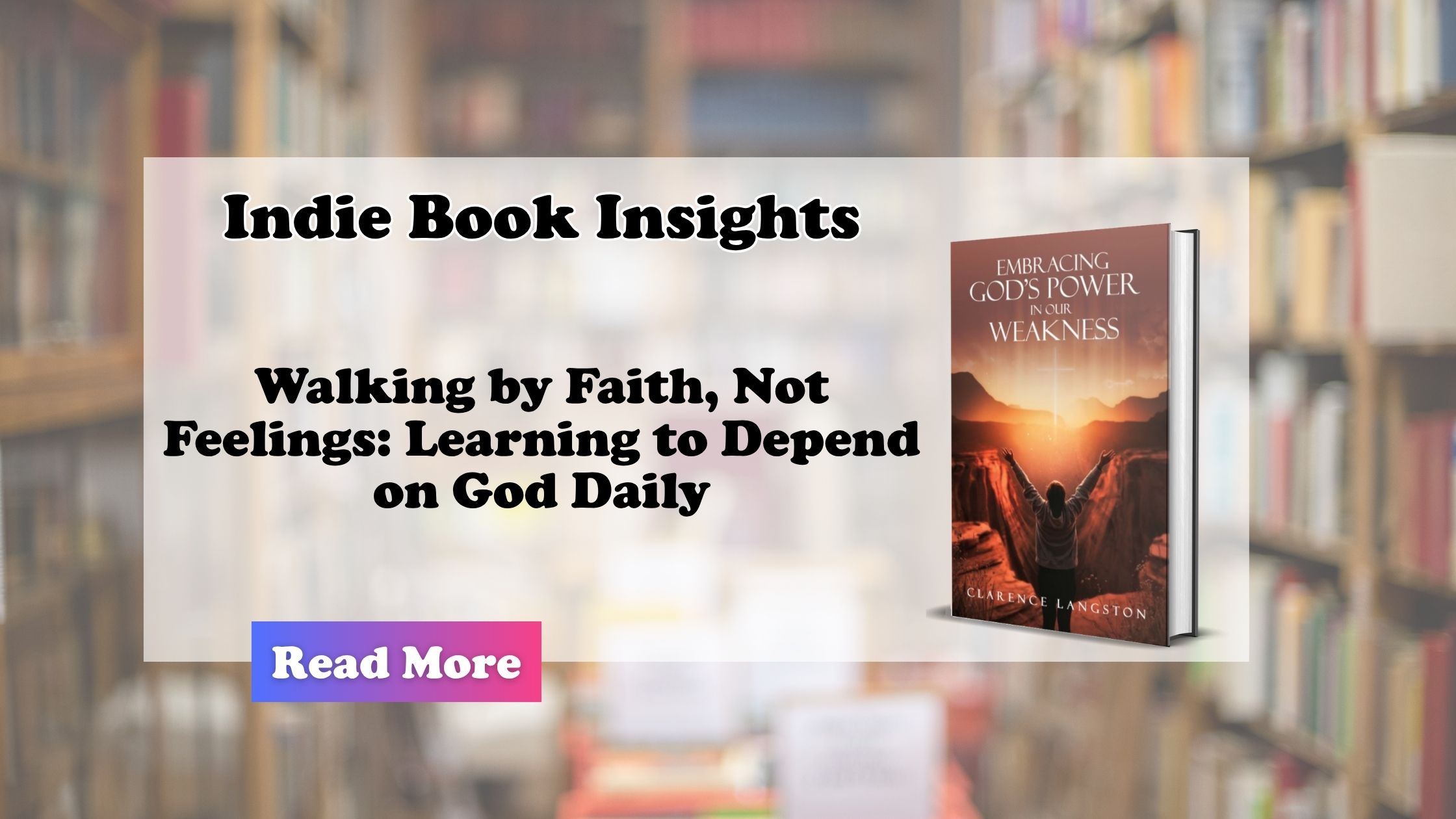
This is the heart of Embracing God’s Power in Our Weakness by Clarence Langston, a book that challenges believers to move beyond emotional dependence and step into a deeper trust in God. One of its central truths is simple yet life-changing: walking with God means learning to trust Him even when feelings say otherwise.
Feelings are real, but they are not always reliable. They change based on circumstances, stress, fatigue and external pressures. If a believer relies solely on feelings, their spiritual life becomes unstable, shifting with every emotional wave. This is why the Bible repeatedly emphasizes faith over sight and trust over understanding.
2 Corinthians 5:7 states, “For we walk by faith, not by sight.” This verse is not just about physical vision; it is about choosing to live according to God’s truth rather than emotional perception. Faith is not the absence of feelings; it is the decision to trust God even when feelings are uncertain.
Clarence Langston emphasizes that walking by faith is a daily discipline. It is not something practiced only in crisis moments, but in everyday decisions, thoughts and responses as well. It is waking up and choosing to trust God before emotions have a chance to dictate your direction. It is praying even when you don’t feel like it, obeying even when you are unsure and believing even when circumstances seem unchanged.
One of the greatest challenges believers face is the pressure to “feel spiritual” in order to believe God is near. But Scripture reveals a deeper truth: God’s presence is not determined by emotional awareness. In fact, Hebrews 13:5 reminds us that God will never leave nor forsake His people. That means even when you feel distant, God is still present. Even when emotions feel empty, His promises remain full.
Walking by faith requires learning to distinguish between truth and feeling. Feelings may say, “You are alone,” but faith declares, “God is with me.” Feelings may say, “This situation will not change,” but faith says, “God is still working.” Feelings may say, “You are not strong enough,” but faith says, “God’s strength is made perfect in weakness.”
This shift does not happen instantly; it is cultivated through daily dependence on God. One of the most practical ways to grow in faith is through consistent prayer and meditation on Scripture. When you fill your mind with God’s Word, you begin to replace emotional assumptions with spiritual truth. Psalm 119:105 reminds us, “Your word is a lamp to my feet and a light to my path.” God’s Word becomes the stabilizer when feelings try to take control.
Another key principle highlighted in Embracing God’s Power in Our Weakness is surrender. Walking by faith requires letting go of the need to control outcomes. Many emotional struggles stem from the desire for certainty, but faith often grows in uncertainty. Trusting God means releasing the outcome into His hands and believing that His plan is still good, even when it is not fully visible.
The Holy Spirit also plays a vital role in helping believers walk by faith. Romans 8:26 reminds us that when we do not know how to pray or what to do, the Spirit helps in our weakness. This means you are never left to navigate faith alone. Even when emotions are loud, the Spirit provides quiet guidance, strength and reassurance.
Walking by faith does not mean ignoring feelings; it means refusing to be ruled by them. It means acknowledging emotions without allowing them to override God’s truth. Over time, this creates spiritual maturity, where believers are no longer tossed by every emotional wave but are anchored in God’s unchanging nature.
Clarence Langston’s message in Embracing God’s Power in Our Weakness is deeply encouraging: your emotional instability does not disqualify you from a strong relationship with God. Instead, it becomes the very place where you learn to depend on Him more deeply.
When you choose to walk by faith, you begin to experience a different kind of stability, one that does not come from feelings but from trust in a faithful God who never changes. And in that place of daily dependence, faith becomes not just something you believe, but something you live.